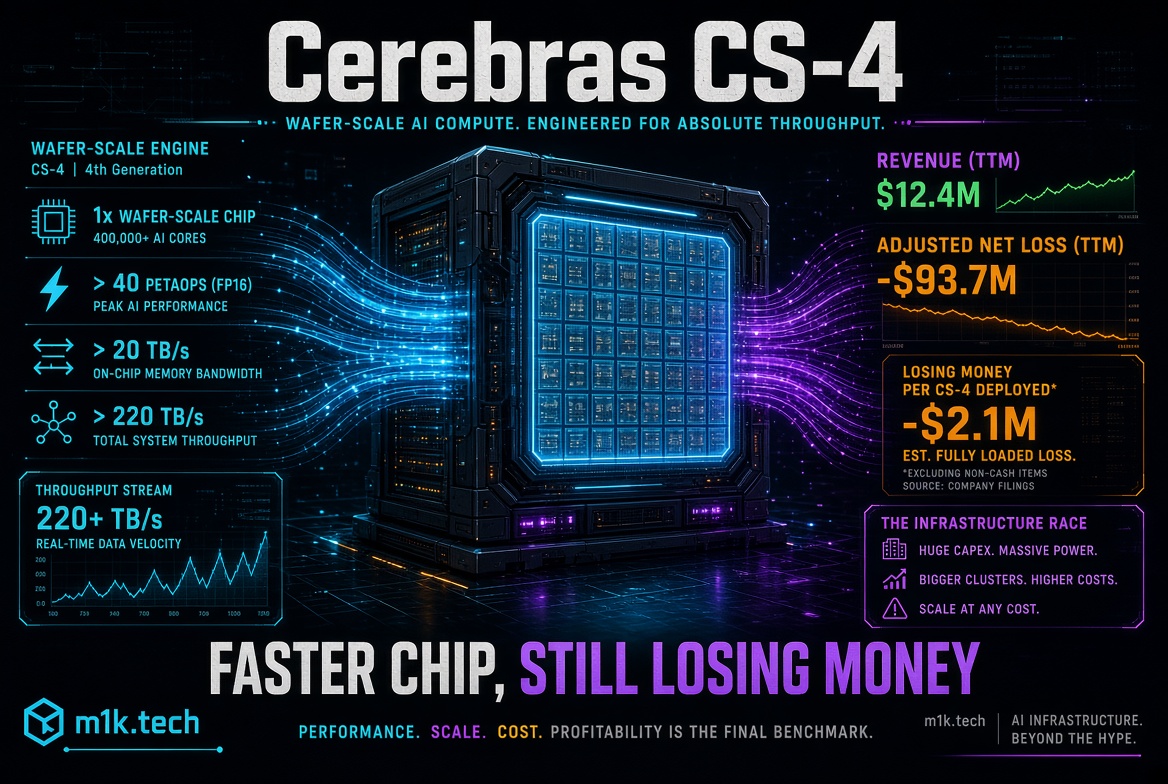
Cerebras stacked three of its wafer-scale chips into a single server rack this week and called it the CS-4. Andrew Feldman stood in front of reporters in San Francisco and said the company will be four times faster by the end of this year and twenty times higher on throughput by the end of 2027. I usually let AI hardware roadmap numbers wash over me at this point; there are so many, but this one landed differently because of what Cerebras reported the same week: an adjusted loss of $6.9 million on sales of $180.1 million.
That is not a company in trouble. It is a company spending heavily to stay in a race where the entry fee keeps rising, and I do not think Cerebras is hiding the tension between those two numbers so much as betting the market will keep forgiving it as long as the throughput claims stay ahead of the losses.
The CS-4 itself is a genuine piece of engineering, not just a marketing wrapper around last year’s chip. It runs on Cerebras’ Nexus server architecture, three WSE-3 Turbo dies per rack, connected through new networking components CTO Sean Lie says will speed how fast data moves between them, which is the whole reason Cerebras chips are fast in the first place: they are large enough to avoid a lot of the energy cost and latency of shuttling data chip to chip the way a GPU cluster has to. The chips come off TSMC’s 5 nanometer line, the same node AMD’s Helios uses, and Cerebras says the new rack needs half as many components as the last generation, which should mean data centers can stand these up faster. It ships in the third quarter. A next-generation chip and server are already planned for 2027.
Look at how many different axes companies are now competing with Nvidia on, and how none of them are really about raw chip speed anymore. AMD shipped Helios into production this summer and argued the CUDA moat has already drained, betting on software portability instead of architecture. Jim Keller’s Tenstorrent welcomed Cerebras to the wafer-scale party and then promised to beat everyone with boring DRAM bandwidth instead. Nvidia, meanwhile, is barely competing on chip design right now. It is competing on financing, backing $500 billion worth of Wall Street deals to make sure the AI buildout keeps happening on its silicon regardless of who else shows up with a faster part. TSMC’s own packaging capacity is so tight from Nvidia’s orders that CoWoS work is spilling out to outside assembly houses just to keep up. Cerebras picked the hardest and most technically honest fight of the bunch, the architectural one. It is also, on this week’s numbers, the most expensive one to keep fighting.
I want to believe the four-times and twenty-times figures, and I also want to point out that “by the end of 2027” does a lot of work in that sentence. Etched, a much smaller and much younger inference chip startup, just doubled its own valuation to $21 billion in a single month on the same story: money chasing anyone who can plausibly claim to out-architect Nvidia, profitability optional for now. I am not convinced the throughput race and the balance sheet race pull in the same direction for Cerebras much longer. Cerebras’ order backlog by customer is still opaque, and I’d rather wait for real deployment figures than repeat briefing-room claims.
None of this makes the CS-4 a bad product. The engineering case is real, and TSMC’s own capacity crunch is proof there is genuine demand for alternatives to Nvidia’s queue. I just don’t think a company can promise 20x throughput gains and post a loss in the same week and have both numbers mean what the press release wants them to mean. Watch what the CS-4’s actual order book looks like in six months. That will tell you more than either number does today.
Sources
- Reuters, Cerebras launches new server chip system designed to speed AI chatbots, August 19, 2026
- Reuters, Cerebras raises annual targets on strong AI chip demand, August 12, 2026
- TechCrunch, Etched’s valuation doubles to $21B in a month, August 18, 2026