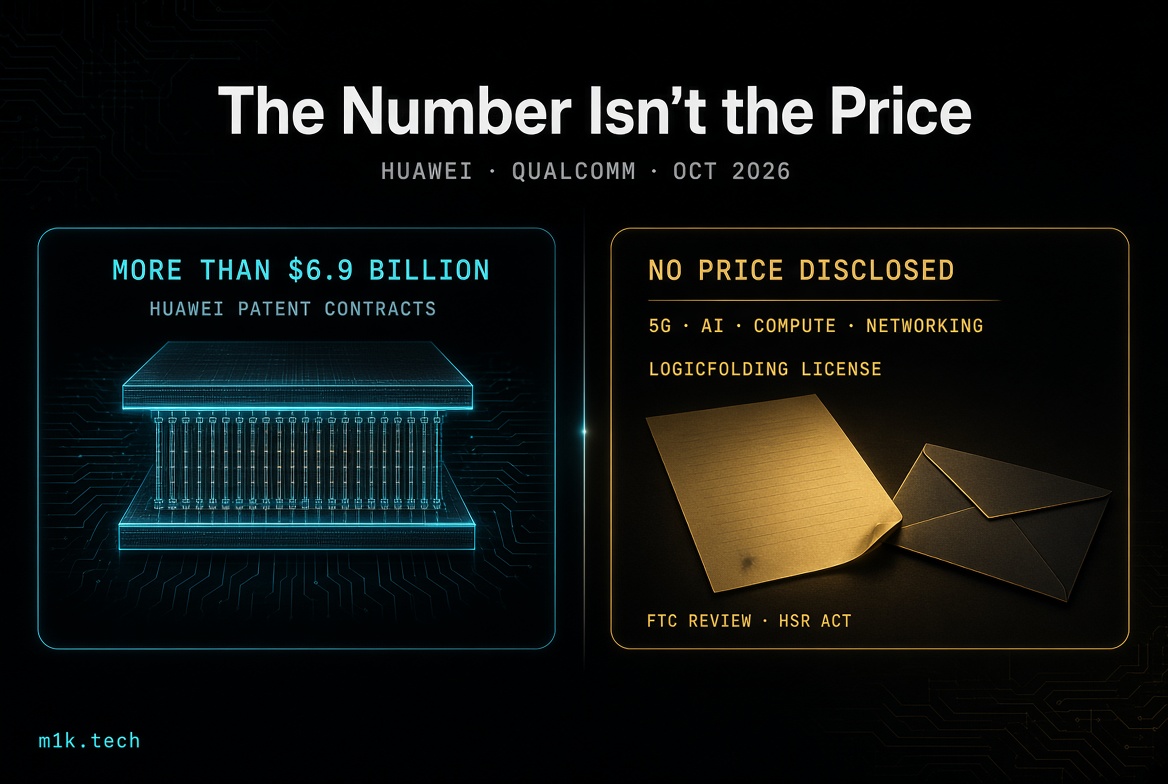
The Huawei-Qualcomm patent deal arrives with exactly one dollar figure, and it belongs to Huawei: once this closes, the company expects its patent licensing contracts to total more than $6.9 billion. Both press releases leave unsaid what Qualcomm pays, what Huawei pays, and whether the cross-license nets out to a check in either direction.
The announcement is a multi-year, broad license with cross-licenses across 5G, compute, AI and networking, plus Qualcomm buying certain Huawei U.S. patents in compute, AI, networking and other areas. The purchase closes after regulatory approvals. TNW notes this is the first licensing deal between the two to cover 5G, which sits oddly next to the history: Huawei made its first licensing payment to Qualcomm in 2001. Both companies say the terms follow FRAND principles, and Qualcomm’s licensing chief, John Han, calls the deal recognition of the success of Qualcomm’s 5G SEP licensing program. I read that last line as the sentence the whole agreement was built to produce.
The patent purchase interests me more than the license. Cross-licenses are housekeeping between companies that have circled the same standards for two decades, but Qualcomm buying U.S. patents from a company that trade restrictions have squeezed since 2019 needs a regulator to say yes, even though those restrictions don’t automatically block patent deals. Bloomberg reports the transaction is subject to FTC review under the Hart-Scott-Rodino Act, which applies to deals valued above $133.9 million. That threshold is statute, not disclosure, so it tells me nothing about the price. It does tell me somebody expects a review, and I’d like to know whether that is caution or arithmetic.
Bloomberg also says the patents Qualcomm is licensing underpin LogicFolding, the technique at the center of my piece on the Kirin 9050 Pro being folded in half: fifty million vertical interconnects, about 1.5 micrometers apart, bonding two layers of silicon so a single CPU core lives on both floors. Bloomberg frames the approach as Huawei’s way of making up for missing EUV machines, so a Western chip designer licensing the result is the closest thing to a quiet endorsement Huawei is likely to get from San Diego. It doesn’t mean Qualcomm ships a folded chip. A Huawei spokesperson also listed near and co-packaged optics among the covered areas, and my guess is that half of the deal matters sooner, given that Huawei just pulled the Ascend 960DT forward three quarters.
Standard-essential patents have had a loud summer. A court in Casablanca granted an injunction against Tecno and Itel in the Ericsson v. Transsion fight in July, and less than two weeks ago Qualcomm announced its Apple license renewal in a release with no term and no number. This one, as far as I can find, has no court behind it, which makes it the polite version of the same business: bring a big standards contributor inside the program and publish a quote.
I’m leaving the 6G spectrum fight out of this, since the Shanghai radio conference in late 2027 is its own argument and I covered the opening moves in the West’s pre-emptive 6G war. I still can’t tell you what one dollar of this deal looks like, and until a filing does, I’m treating “recognition” as the press-release word for a payment.
Sources
- Qualcomm Newsroom, Huawei and Qualcomm Announce Broad Patent License Agreement, October 5, 2026
- Huawei, Huawei and Qualcomm Announce Broad Patent License Agreement, October 5, 2026
- TNW, Huawei and Qualcomm sign patent deal covering 5G, AI and networking, October 5, 2026
- Bloomberg via Yahoo Finance, Qualcomm Licenses Patents on Huawei’s LogicFolding Chip Tech, October 5, 2026