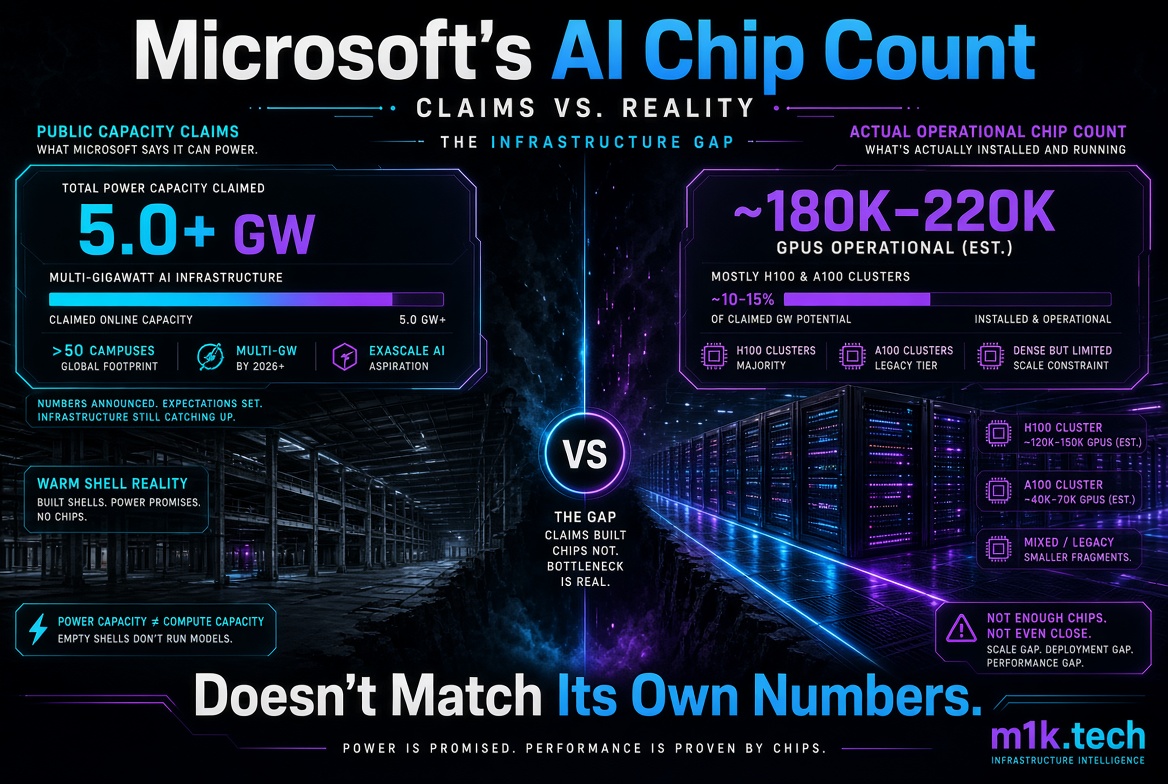
Two point two million. That’s the number of AI chips in Microsoft’s data centers right now, according to internal documents a Guardian investigation obtained, and it’s barely above the 1.8 million-chip target Microsoft set for itself in 2024. Two years and roughly $280 billion of infrastructure spending later, Microsoft’s AI chip count has grown by less than half a million chips, which is not the number anyone modeling this buildout from the outside expected to see.
Nobody outside Nvidia and its biggest customers actually knows how many AI chips get sold to whom. Nvidia doesn’t report shipment breakdowns by customer, and the hyperscalers buying them don’t publish chip counts either, so the entire public understanding of the AI buildout runs on gigawatt figures companies volunteer in earnings calls and investor decks. That’s the gap Guardian reporters Aisha Down and Ed Zitron tried to close, working backward from Microsoft’s own claimed power capacity to estimate how many chips that capacity should represent, then comparing it against what internal documents actually show.
The arithmetic is blunt. An H100, still the workhorse chip inside most of Microsoft’s fleet, draws about 700 watts. Microsoft says it added roughly 5 gigawatts of datacenter capacity in the past two years and had already claimed 5 gigawatts installed as of a 2024 investor presentation, which implies a rough total north of 10 gigawatts today. Divide that by 700 watts and you land near 12 million chips before accounting for cooling and overhead. Knock that down to the roughly 80 percent of datacenter power that typically reaches the compute itself, and you’re still well into the millions. Microsoft’s own documents put the figure at 2.2 million, mostly older H100 and A100 parts. Even a far more conservative read of Microsoft’s 2024 capacity, closer to 1.2 gigawatts rather than 5, still implies something like 4 million chips should be running today.
The Blackwell numbers tell a similar story. Nvidia’s Jensen Huang said last year that orders from the company’s top four customers, widely assumed to be Amazon, Oracle, Microsoft and Google, totaled 3.6 million Blackwell GPUs. If Microsoft holds anything like its historical share of Nvidia’s biggest accounts, that should put its Blackwell count somewhere near a million. The documents the Guardian saw show less than half that.
Some of this is explained by sites that exist more on paper than in reality. Satellite imagery from Epoch AI of Microsoft’s flagship Fairwater campus in Wisconsin shows only part of the facility actually built out, and Microsoft told a local Wisconsin newspaper in May that the site wasn’t yet online, weeks after Nadella had posted that it “is going live.” An analyst quoted in the piece, Ren, put it plainly: what started as a multi-gigawatt, multibillion-dollar project has produced about 300 megawatts three years in.
Nadella himself said the quiet part out loud on a podcast late last year, and it’s the single most useful sentence in the whole story. Asked about the buildout’s bottleneck, he didn’t blame Nvidia. “You may actually have a bunch of chips sitting in inventory that I can’t plug in,” he said. “It’s not a supply issue of chips. It’s actually the fact that I don’t have warm shells to plug into.” Read that next to the missing millions of chips, and the picture gets less mysterious: some of this gap is probably real silicon sitting in a warehouse somewhere, not yet connected to power, not yet inside a building rated to hold it.
Microsoft’s response to all this is what annoys me most. Asked to explain the discrepancy, a spokesperson said the Guardian’s numbers were “based on incorrect information” and drew “the wrong conclusions from incorrect assumptions,” without saying which numbers were wrong or offering a corrected figure. That’s not a rebuttal. It’s a company that would rather let the ambiguity sit than clear it up, and the ambiguity happens to favor a narrative of unstoppable AI momentum that its stock price depends on.
I’ve spent a chunk of this summer writing about different pieces of this same puzzle without quite naming the whole shape of it. TSMC’s CoWoS packaging capacity is the reason Nvidia itself says it’s supply constrained, which made me assume the binding constraint on AI buildouts sat upstream, at the chip and packaging level. Nvidia’s $500 billion vendor financing arrangement with Wall Street is built on the assumption that hyperscalers just need help affording more chips, faster. And I wrote at length about how Armenia’s Firebird AI factory needs more power than its entire national grid was built to provide, treating that as a story about one small country’s unusual constraints. Microsoft’s numbers suggest the power and site readiness problem isn’t unusual at all. It might be the actual bottleneck at the biggest, best-funded AI buildout in the world, not a periphery case.
I don’t think this means the AI buildout is fake, and I don’t think Microsoft is lying exactly. I think it means the gigawatt figures every hyperscaler puts in an earnings deck are doing a lot of narrative work that the actual, physical, plugged-in chip count can’t back up yet. Nobody’s going to get a clean number here until someone besides the vendor starts counting, and right now the only people counting are reporters doing the math from the outside in.
Sources
- The Guardian, Are Microsoft’s AI plans being held back by a shortage of chips?, August 17, 2026