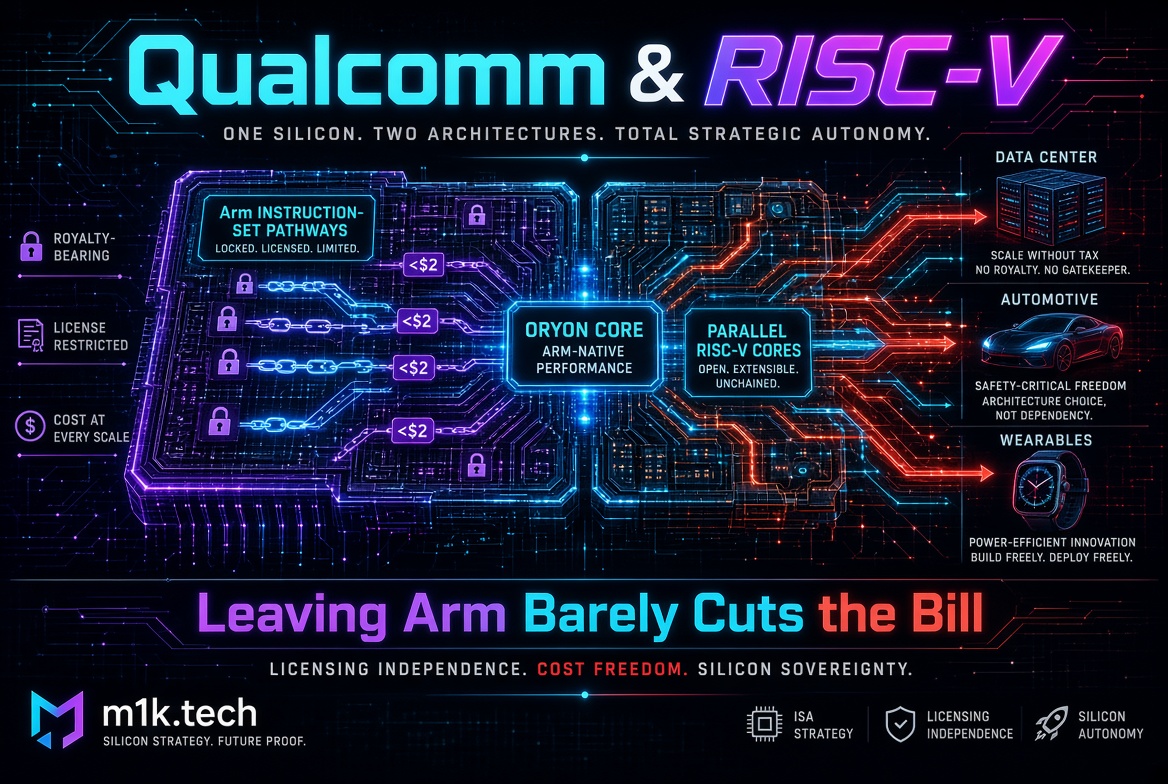
When I wrote up the Nuvia verdict, I left one thread hanging on purpose, and this is it. Every time Qualcomm buys another RISC-V asset, the headline writes itself: the company is building an escape route from Arm. The Ventana deal closed in December, the Tenstorrent talks leaked in June, and the framing hardened into consensus. So let me actually price the escape. What would it cost Qualcomm to walk away from Arm and stand up its high-end chips on RISC-V instead? The Qualcomm RISC-V story only makes sense once you separate two numbers that usually get mashed together, and the one everyone points to, the royalty, turns out to be the small one.
Start with what Arm actually collects. Analysts have pegged Arm’s royalty at somewhere around one to two percent of a chip’s selling price, and a premium Qualcomm application processor sells for something in the neighborhood of forty dollars. Do that arithmetic and you land at well under a dollar to a couple of dollars per chip. For contrast, Apple, which holds an architecture license and designs its own cores, reportedly pays Arm less than thirty cents a unit. Qualcomm negotiated its own deal years ago and pays comfortably less than Nuvia did as a standalone, which is the entire reason Arm went to court trying to drag the Nuvia cores onto a pricier contract. Even the nightmare scenario, Arm’s long-floated plan to charge on the price of the finished phone instead of the price of the chip, is a leverage play about future pricing, not a bill Qualcomm is paying today. If the only goal were to stop writing Arm a royalty check, no sane finance chief signs off on re-engineering an entire product line to save a rounding error. Qualcomm is roughly nine percent of Arm’s revenue, and that number describes Arm’s exposure to Qualcomm far better than it describes Qualcomm’s dependence on Arm.
The expensive part of leaving was never the money. It is the software that sits on top of the silicon, and specifically the platforms Qualcomm does not own. Android is the whole problem in miniature. Google announced official RISC-V support back in 2022, talked about making it a tier-one platform, then in 2024 quietly pulled RISC-V out of the Android Common Kernel, which meant certified Android builds would no longer boot on a RISC-V chip without someone rebuilding the plumbing by hand. Google has warmed back up since and is maturing support again around the newer profiles, but the message to anyone watching was unmistakable: the timeline belongs to Google, not to the chip vendor. A phone SoC is useless if the operating system it needs will not reliably run on it, and Qualcomm cannot unilaterally decide that Android runs on RISC-V. The Windows side is the same shape with a different owner. Snapdragon X laptops already lean on x86 emulation to run legacy apps, and Oryon carries hardware assists just to make that translation tolerable. Adding a second instruction set underneath all of that means years of compatibility work handed to a partner who has to want it too.
Here is the nuance that gets lost. The core itself is the part Qualcomm could most plausibly move, and it still chose not to. Oryon is Qualcomm’s own microarchitecture. Gerard Williams III has said it carries one percent or less of Arm’s original technology, because the pipelines and execution units were designed from scratch. What is Arm about it is the instruction set the front-end decodes, the Armv8.7 encoding the machine was built to speak. Swapping that front-end to decode RISC-V instead, while keeping the expensive out-of-order back-end, is a real engineering project but a bounded one. And Qualcomm did not do it. It bought Ventana instead, a team that already ships a high-performance RISC-V server core, the Veyron, built to the modern RVA23 profile. So the company now runs an Arm-native core program and a RISC-V core program side by side, on purpose. That is the tell. The plan was never to convert Oryon into a RISC-V part. It was to own both and never be cornered again.
Look at where the RISC-V pieces are actually going, and the logic snaps into focus. Ventana and the Tenstorrent talks point at the data center, where the software stack is Linux and a compiler Qualcomm can shape itself rather than an app store it has to beg into. The Quintauris venture Qualcomm co-founded with Bosch, Infineon, NXP and the rest, now six members deep with its RT-Europa profile, aims RISC-V at automotive, another domain where the platform owners sit in the room. The oldest thread runs through wearables and the humble microcontroller, where Qualcomm has shipped RISC-V blocks inside its own SoCs since the Snapdragon 865 in 2019 and partnered with Google on a RISC-V Wear OS chip. Notice what is missing from that list. The flagship phone application processor, the crown jewel, stays on Arm. RISC-V goes exactly where Qualcomm or its partners hold the software, and Arm stays exactly where Google and Microsoft hold it.
Which is how I would answer the original question. Framed as pure cost, leaving Arm is close to irrational: you spend a fortune re-tooling to stop paying a pittance. The reason Qualcomm is doing it anyway has nothing to do with the arithmetic and everything to do with the Nuvia fight I wrote about recently. Arm did not just license Qualcomm a design; it sued to terminate the license and threatened to blow up a shipping roadmap, and it now sells cores that compete directly with its own customers. Once your landlord becomes your rival, the rent stops being the point. The RISC-V spending is insurance against a supplier who has shown, in open court, that it will use the leverage a proprietary instruction set gives it. That optionality is worth far more than the royalty line, and it is the only reading of these deals that survives contact with the numbers.
One thing I am deliberately not pricing here, and it matters, is the geopolitics. RISC-V being an open standard makes it attractive to a Qualcomm that wants independence, but that same openness has put the instruction set under a US export-control microscope, and the China dimension changes the calculus in ways that deserve their own post rather than a paragraph bolted onto this one. I wrote separately about how ISA control and foundry access are reshaping who can build a CPU at all, and that is where this thread properly continues.
So the honest answer to what it would cost Qualcomm to walk away from Arm is almost funny. The bill Arm sends every quarter is the smallest number on the page. Everything expensive about leaving lives in software Qualcomm does not control, and everything valuable about being able to leave lives in never having to spend it. Qualcomm is not buying a cheaper chip. It is buying the right to say no.
Sources
Qualcomm’s RISC-V acquisitions and strategy: The Register, “Qualcomm takes RISC on Arm alternative with Ventana acquisition,” https://www.theregister.com/2025/12/10/qualcomm_riscv_arm_ventana/ ; TechTimes, “Qualcomm Pursues Tenstorrent at Up to $10 Billion,” https://www.techtimes.com/articles/318559/20260617/qualcomm-pursues-tenstorrent-10-billion-risc-v-bet-nvidias-blind-spot.htm
Arm royalty economics: SemiAnalysis, “Arm and a Leg: Arm’s Quest To Extract Their True Value,” https://semianalysis.com/2023/09/14/arm-and-a-leg-arms-quest-to-extract/ ; Tom’s Hardware, “Apple pays Arm less than 30 cents per chip in royalties,” https://www.tomshardware.com/news/apple-pays-arm-less-than-30-cents-per-chip-in-royalties-new-report-says
Oryon architecture: Tom’s Hardware, “Qualcomm says its Oryon CPU cores have 1% or less of Arm’s original technology,” https://www.tomshardware.com/pc-components/cpus/qualcomm-says-its-oryon-cpu-cores-have-1-percent-or-less-of-arms-original-technology-cores-in-snapdragon-x-pc-chips-are-almost-entirely-custom
Android on RISC-V: Google Open Source Blog, “Android and RISC-V: What you need to know,” https://opensource.googleblog.com/2023/10/android-and-risc-v-what-you-need-to-know.html ; The Register, “Google pulls RISC-V support from generic Android kernel,” https://www.theregister.com/2024/05/01/riscv_support_android_pulled/
Quintauris automotive venture: EE Times Asia, “Bosch, Infineon, Nordic, NXP, and Qualcomm Establish Quintauris,” https://www.eetasia.com/bosch-infineon-nordic-nxp-and-qualcomm-establish-quintauris-to-advance-adoption-of-risc-v/ ; Hackster, “RISC-V Joint Venture Quintauris Grows to Six,” https://www.hackster.io/news/risc-v-joint-venture-quintauris-grows-to-six-as-stmicroelectronics-joins-the-party-b3936a803e0d