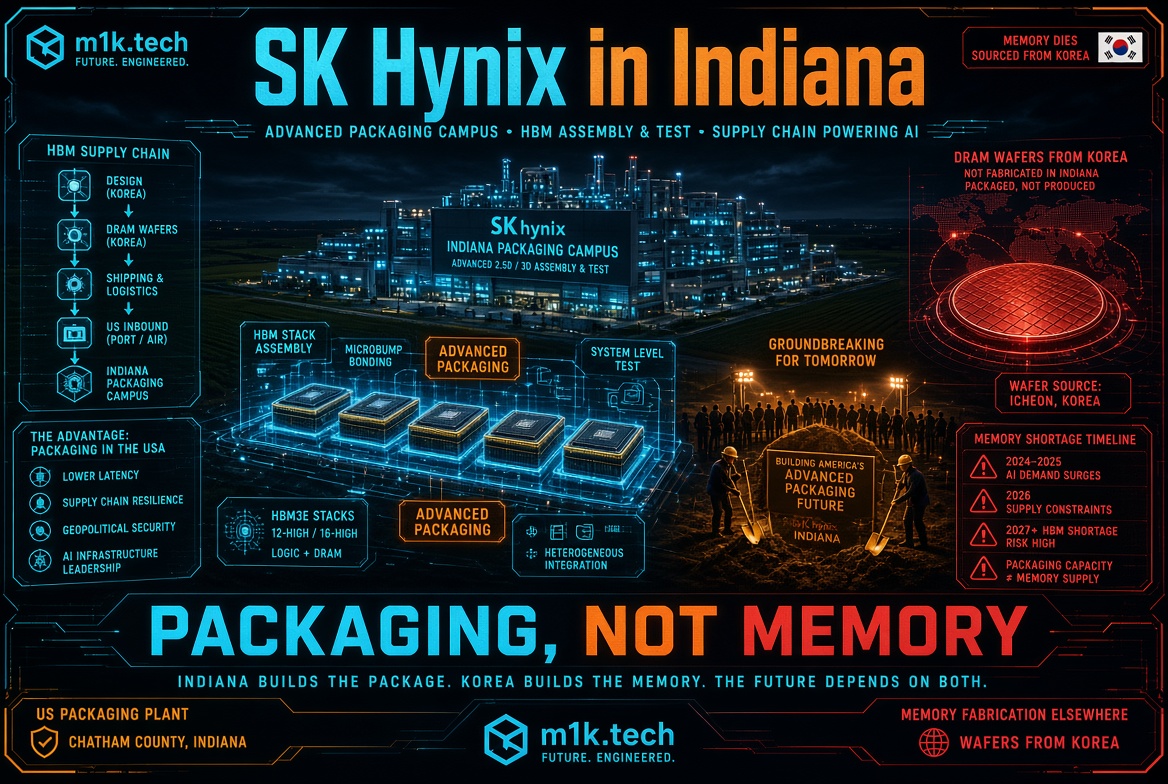
SK Hynix broke ground Thursday on its first US factory, a $4 billion site at Purdue Research Park in West Lafayette, Indiana, and the memory chips America keeps hearing it needs won’t actually be made there.
Read the fine print, and the Indiana site is an advanced packaging line for HBM4E plus an AI semiconductor R&D facility, not a wafer fab. The DRAM dies that get stacked into finished HBM will still be grown in Korea. Indiana’s job is stacking them, testing them, and shipping them out the door, which is a real and useful thing to build domestically, just not the thing most of the coverage this week implied.
The timeline makes that gap concrete. Cleanroom operations don’t start until the second half of 2028. CEO Kwak Noh-Jung said volume production of the next-generation HBM4E chips won’t begin until the third quarter of 2029, more than three years from now. Then, in the same appearance, Kwak said the memory shortage currently driving prices through the roof will likely persist through the end of 2030. Sit with that arithmetic for a second: the plant meant to help with the shortage doesn’t ship product until roughly a year before Kwak’s own deadline for the shortage to end. This isn’t a near-term fix. It’s a multi-year bet that the shortage still has legs when the ribbon finally gets cut.
I’ve been tracking this shortage since it first showed up as a number rather than a vibe, and Kwak’s 2030 comment is longer than anything I’d seen guided to publicly before this week. DRAM contract pricing is already up something like 700 percent since 2022, a climb steep enough to draw its own antitrust complaint against Samsung, SK Hynix, and Micron. It reached actual retail prices in July, when Samsung added $100 to its foldable lineup and pointed at memory costs. And it’s the same pressure that’s letting China’s CXMT climb from a standing start to roughly 8 percent of global DRAM revenue, because the incumbents chasing HBM margins left the boring commodity end of the market wide open. None of that gets fixed by a facility that won’t start shipping until 2029.
The ceremony itself had the trappings of a bigger deal than the underlying timeline supports. Indiana Governor Mike Braun showed up. Purdue’s interim president, Mitch Daniels, said, “In 167 years at Purdue University, there has not been a bigger day than today,” which is a hell of a sentence for a packaging plant, however genuinely it was meant. SK Hynix expects around 1,000 direct jobs on site plus roughly 6,000 more tied to construction and supply-chain partners, backed by $458 million in CHIPS Act grants and up to $500 million in loans that were finalized back in December 2024, well before anyone broke ground on anything.
Context arrived a day early and did the argument for them. Nvidia, SK Hynix’s biggest customer and the counterparty on a $500 billion memory supply deal from July, forecast a 70 percent jump in next fiscal year’s revenue on Wednesday, the day before this ceremony. That’s the kind of number that makes “shortage through 2030” sound less like caution and more like confidence that the AI buildout isn’t slowing down anywhere close to that horizon.
Kwak’s answer to a reporter’s question about Solidigm, SK Hynix’s NAND flash subsidiary, was almost buried in the coverage. Asked whether the company had shelved plans for a US IPO of that unit, Kwak said it’s still under discussion, with no decision to abandon it either. I’m not going to pretend that’s the headline here, but it’s a reminder that SK Hynix has more moving pieces in play than one groundbreaking ceremony can hold, and that the company treats “still deciding” as an entirely normal place to leave a billion-dollar question hanging.
“Key HBM production base in America by 2030” is technically true if you count packaging as production, and I’d bet the marketing keeps using exactly that framing right up until someone asks where the wafers actually come from. Even the packaging technology itself is still in flux, with hybrid bonding likely slipping past HBM4 and into a later generation. None of that makes Thursday’s announcement meaningless. A thousand jobs are real. The R&D lab is real. The eventual capacity is probably real too. What isn’t real yet is any of it changing the price you pay for memory before 2028 at the absolute earliest, and Kwak just told everyone in the room it might not change through 2030 either. Ground gets broken on a schedule. Shortages don’t end on one.
Sources
- Reuters, SK Hynix to start AI chip volume production in Indiana by 2029, August 27, 2026
- CNBC, SK Hynix CEO says Indiana will be key memory production base by 2030, August 27, 2026