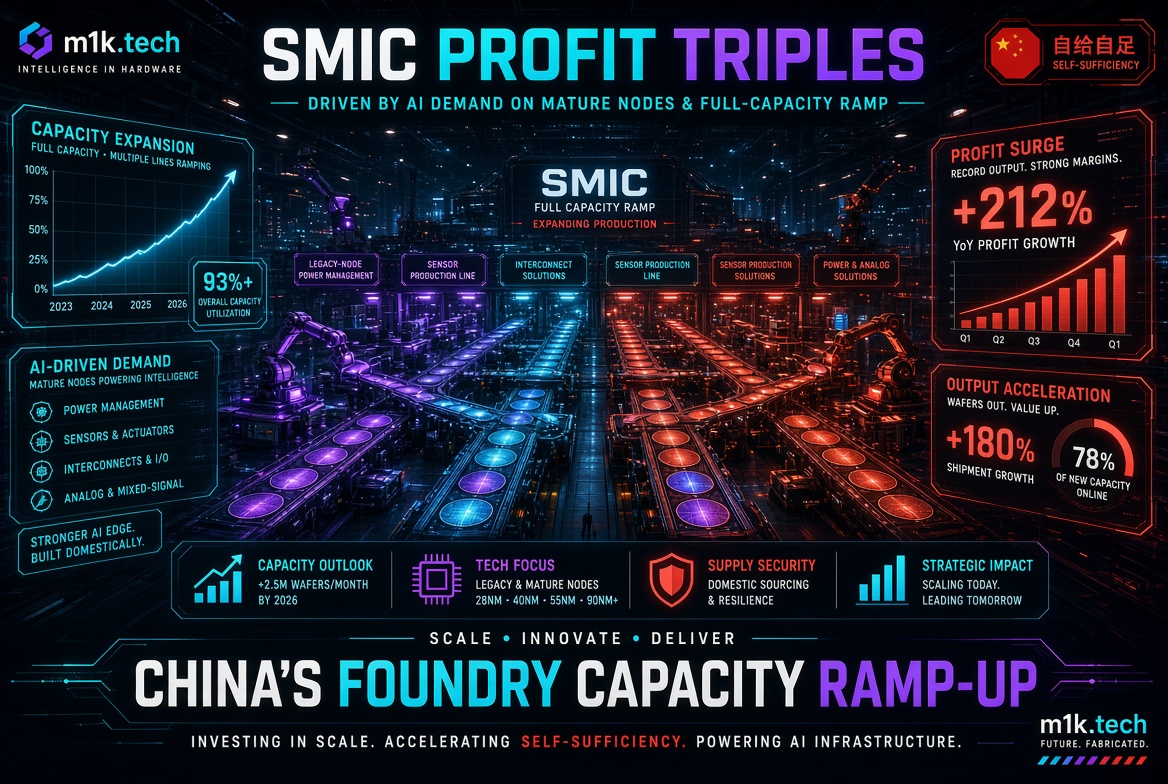
SMIC posted second quarter net profit of $479.2 million this week, more than tripling last year’s number and landing at almost double what analysts had penciled in. Revenue crossed $3 billion, up 36 percent. Those are the kind of numbers that would normally get filed under “another good quarter for a chipmaker” and forgotten by Friday, except SMIC said something in the same breath that matters more than the earnings beat: it’s accelerating new production line ramp up specifically to ease industry wide supply constraints, and expects AI driven chip demand to stay strong through the rest of the year.
I’ve written before about SMIC’s origin story, the bet that China’s door to advanced manufacturing tools would stay open long enough to build a real domestic foundry before Washington slammed it shut. That door didn’t stay open, not fully, and the N+1 node work has spent years proving what a 7nm class process looks like when you’re locked out of EUV lithography and have to fake your way there with multi patterning DUV instead. What’s changed this quarter isn’t the technology ceiling. It’s the demand curve slamming into that ceiling from below.
China’s chip exports were already up nearly 89 percent earlier this summer, and that surge was mostly legacy nodes feeding a domestic AI buildout that has nowhere else to source silicon from. SMIC’s earnings call is the capacity side confirmation of the same story: demand for AI adjacent chips (not the bleeding edge stuff Nvidia sells, but the surrounding silicon, the power management, the sensors, the legacy node logic that every AI server rack still needs by the thousands) is outrunning what SMIC can currently build, and the company is responding by throwing more fab lines at the problem rather than just raising prices and pocketing the margin.
A foundry accelerating capacity build out to relieve supply constraint is usually a story about a company trying to grab market share before a rival does. Here it reads more like triage. China’s fabless CPU industry and the HiSilicon comeback I’ve covered both depend on domestic foundry capacity existing at a scale that can actually support them, not just prove a node works in a lab. SMIC turning a quarter this strong while explicitly saying the bottleneck is still capacity, not demand, tells you the constraint the whole China self sufficiency push runs into isn’t cleverness anymore. It’s fab count.
None of this means SMIC has caught up to TSMC or Samsung on the leading edge, and I’m not going to pretend a 36 percent revenue quarter closes that gap. What it does mean is that the export control regime built around denying China EUV access is increasingly running into a China that doesn’t need EUV to keep its AI buildout fed, at least not yet, because so much of what an AI data center actually consumes in volume sits several process generations behind the chip everyone argues about. SMIC’s profit margin is the receipt for that arbitrage.
I’d watch the second half guidance more than the Q2 beat. SMIC saying demand stays robust through the rest of the year is a forecast, not a fact, and foundries have a long history of getting utilization projections wrong in both directions. But if the ramp up materializes the way SMIC is describing it, the supply constraint story around Chinese AI hardware gets a lot less interesting a lot faster than the export control headlines would have you believe.
Sources
- Reuters, China’s SMIC posts profit more than triples on AI-driven chip demand, August 13, 2026