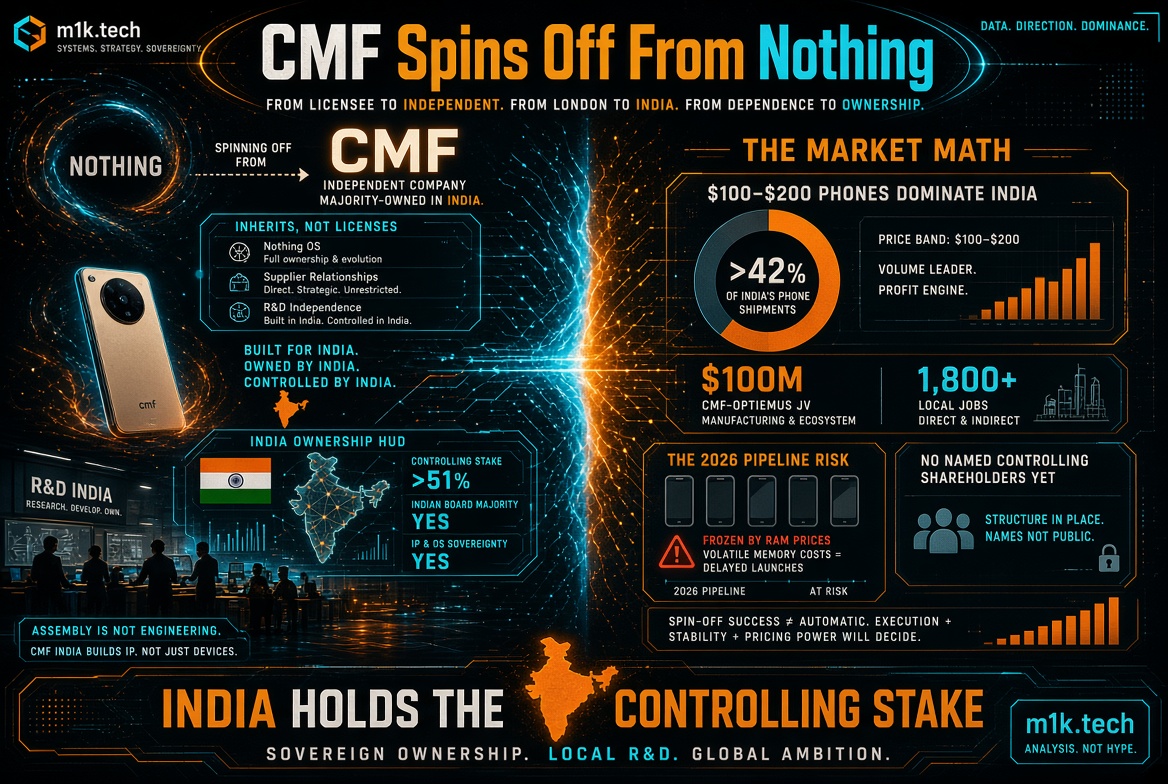
Carl Pei spent Sunday night on X confirming the CMF spin-off from Nothing is now a fully independent company, majority-owned in India, with its own research and development team on the ground. Nothing keeps a seat at the table, but only as a minority partner in a phone business it once owned outright.
The move builds on a commitment from Nothing’s own 2027 doubling plan: a September 2025 pledge of over $100 million into a joint venture with contract manufacturer Optiemus, aimed at roughly 1,800 local jobs over three years. CMF India Private Limited got its paperwork filed in December. What changed this week is that Pei finally said the quiet part out loud: Indian investors will hold the controlling stake, not Nothing.
The number that explains why is one I hadn’t seen before Sunday. IDC put devices between $100 and $200 at more than 42% of India’s total smartphone shipments in the second quarter of 2025 alone. That’s not a niche corner of the market. That’s close to half a country’s phone sales sitting in a band Apple and Samsung’s premium tiers structurally can’t touch, and CMF has been living in exactly that band since it launched in September 2023.
Pei’s actual argument for full independence is more interesting than the ownership headline, and it’s the part I keep coming back to. He pointed to 2015, when Indian domestic brands controlled nearly half the country’s phone sales, almost entirely by reselling catalog designs licensed from overseas ODMs. Foreign competitors showed up with bespoke engineering instead of shelf parts, and domestic share collapsed to under 1% by 2025. Ninety-nine percent of phones sold in India today are assembled there, he noted, but assembly never mattered. Owning your own thermal design, antenna tuning, and camera pipeline matters, and that’s why CMF is taking independence rather than remaining a licensee running someone else’s software forever.
That’s also the logic behind CMF inheriting Nothing OS itself, plus the engineering team and supplier relationships that come with it, rather than staying dependent on a parent company’s roadmap. Pei’s stated endgame is 100 million annual shipments, a volume threshold where a phone maker stops taking whatever components suppliers hand it and starts specifying its own. It’s the same scale logic Oppo ran into with its own India manufacturing deal last month, just applied to ownership structure instead of assembly.
I want to be skeptical of the scale here, because a lot of it is still promise rather than paperwork. Pei hasn’t named the controlling Indian shareholders or published an equity split, and there’s no transition date yet either. Nobody has explained what happens to software support during a handover between two legally separate companies, which matters a great deal to anyone who already owns a CMF phone and expects Nothing OS updates to keep showing up.
And the timing is awkward in a way the announcement doesn’t address directly. CMF isn’t shipping a new phone at all in 2026. Nothing co-founder Akis Evangelidis said back in June that a CMF Phone 2 Pro successor wasn’t financially viable at the brand’s target price given how far memory costs have climbed, so the Phone 2 Pro stays the flagship for the entire year while the company works on unspecified new product categories instead. You can read the independence announcement as confident long-term strategy, or you can read it as a company restructuring its ownership while its actual product pipeline sits frozen by a RAM shortage nobody at CMF controls. I don’t think those two readings conflict, and I doubt Pei would argue they do.
Sources
- Nokiamob, Carl Pei Confirms CMF Will Become an Independent Indian Smartphone Brand, September 21, 2026
- m1k.tech, Nothing’s 2027 Plan Is Twice the Phones, and CMF Phone 3 Pro Is Still Hostage to RAM Prices, August 8, 2026
- m1k.tech, The CMF Phone 3 Pro Just Became RAM Inflation’s First Casualty, July 28, 2026
- m1k.tech, Nothing OS 5.0’s Open Beta Doesn’t Include the Redesign It’s Named For, August 25, 2026
- m1k.tech, Oppo Just Handed Its India Factory to the Company That Makes One in Four Indian Air Conditioners, August 20, 2026