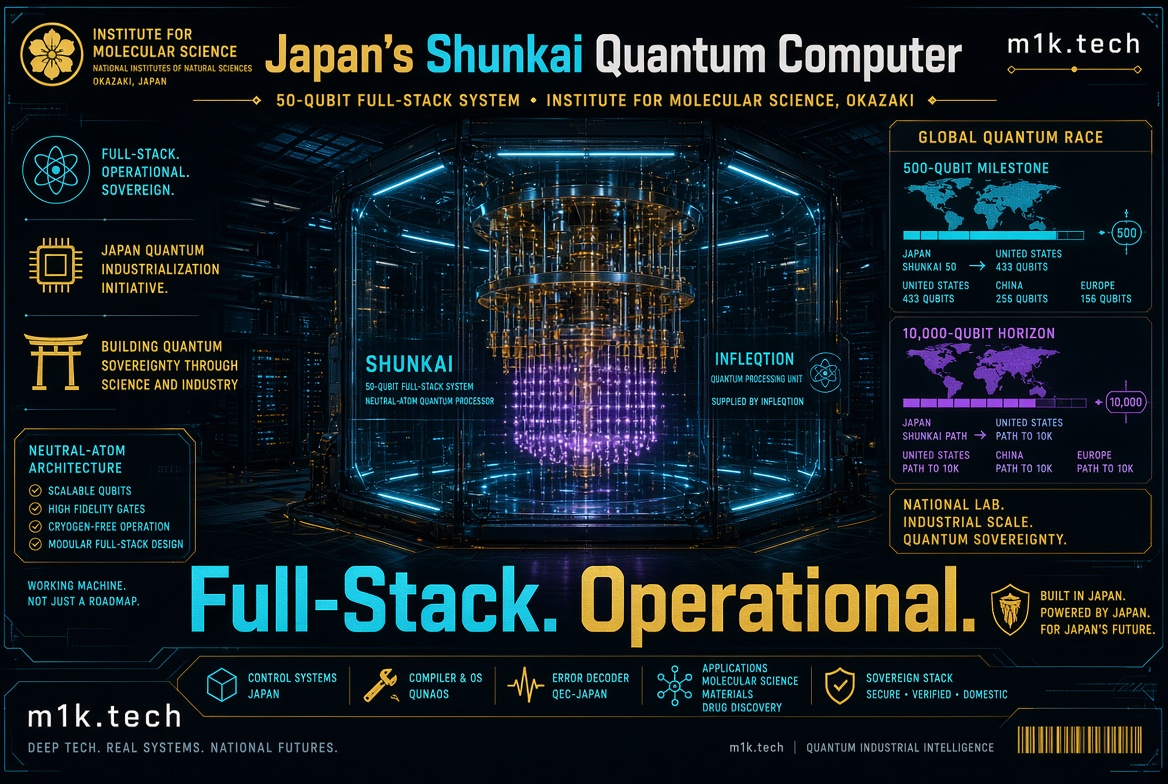
Somewhere in Okazaki this week, Kenji Ohmori’s team at the Institute for Molecular Science flipped the switch on a fifty-qubit machine called Shunkai, and quietly answered the question everyone circling the quantum computing race has been dancing around: whether any of the national money actually turns into working hardware, or just into press releases about working hardware. Infleqtion supplied the quantum processing unit, the same Colorado company that built Chicago’s 50-logical-qubit system, and the roadmap on the wall calls for 500 qubits soon and 10,000 physical qubits with error correction by March 2031. I’ve learned to discount five-year qubit roadmaps by about half on reflex, but “full-stack and operational” is a different claim than “funded,” and Japan just made the harder one.
What makes the timing interesting is that The Quantum Insider ran a sharp piece the same day mapping how quickly this stopped being research funding and became policy. The framing holds up even where the details are still fuzzy: the US has CHIPS Act money flowing into quantum, the UK just added £2 billion to ProQure, Japan is calling this its industrialization year with a headline figure north of a trillion yen, and Canada opened something called the Calgary Quantum DISH that nobody outside the sector had heard of a month ago. Naftali Bennett, whom I didn’t expect to see quoted in a quantum funding piece, now sits on Quantum Source’s board and told them flatly that this is a sovereignty question, not a science one. He’s not wrong, and it bothers me a little that a former prime minister had to say it before the framing stuck.
The supply chain argument underneath that framing is the part worth sitting with. Dilution refrigerators, isotopically pure silicon-28, helium-3: none of these show up in an export-control headline the way a lithography tool does, and a handful of companies control all three. That’s the same shape as the bet behind the Illinois Quantum Park’s twenty billion dollars, where a state betting big on a quantum hub is really betting on which supply chains it can secure a seat at, not just which qubits it can print. Japan’s play reads the same way from the other direction: buy the full stack from a company that already has a Chicago deployment, and you’ve bought a supplier relationship, not just a machine.
I keep coming back to how differently this lands in the two places. Chicago’s own quantum park broke ground on 440 acres of old steel slag this month with a neighborhood association demanding a written community benefits agreement before it trusts another word out of the state, and that’s the right instinct in a country that has burned a lot of neighborhoods with exactly this pitch before. Japan’s version of the same industrial bet doesn’t carry that friction yet, partly because the plumbing runs through an existing national lab instead of a real estate deal, and partly because nobody’s proposed putting 10,000 physical qubits next door to a contaminated site.
Infleqtion is the thread tying both bets together, and that’s worth pausing on. One company is now the full-stack vendor behind a US metro’s flagship quantum deployment and a Japanese national lab’s first operational neutral-atom system, inside the same year. That’s either evidence the neutral-atom approach has actually pulled ahead of the alternatives, or evidence that there just aren’t that many companies capable of selling a complete stack yet and everyone serious is buying from the same short list. I lean toward the second explanation. The market for a full-stack quantum vendor with a working product is small enough that two national bets landing on the same name isn’t a coincidence worth reading too much into.
None of this means Shunkai is a big machine. Fifty qubits is a demonstration, not a workload, and IBM had already crossed a billion dollars in cumulative quantum revenue years before Japan’s national lab had a working neutral-atom system at all. What I actually believe, and I’ll admit this is a hunch more than a conclusion, is that the qubit count is the least interesting number in the whole story. The interesting number is the one nobody publishes: how much of that 2031 roadmap survives contact with a paying customer instead of a government grant committee.
I’m skipping the actual physics of neutral-atom architectures here; that’s its own post and a more technical one than a Monday morning brief has room for. What I’ll say instead is that the money chasing quantum sovereignty right now- EuroHPC’s new funding calls, ProQure, the Illinois park, Shunkai- is moving at a pace that assumes the payoff is close. I don’t think it is. I think the payoff is still five to ten years out, no matter how many countries announce industrialization years, and governments spending like it’s closer are betting on being first through the door rather than on the technology being ready. That’s a defensible bet. It’s just not the one most press releases pretend to make.
Sources
- The Quantum Insider, Nations at the Quantum Table, August 24, 2026
- Infleqtion (via Business Wire), Infleqtion Collaboration with Japan Moonshot Program Achieves Major Milestone: ‘Shunkai’ Neutral Atom Quantum Computer Now Operational, August 24, 2026
- The Quantum Insider, EuroHPC Opens €119M in Funding Calls for Quantum Technologies, August 24, 2026