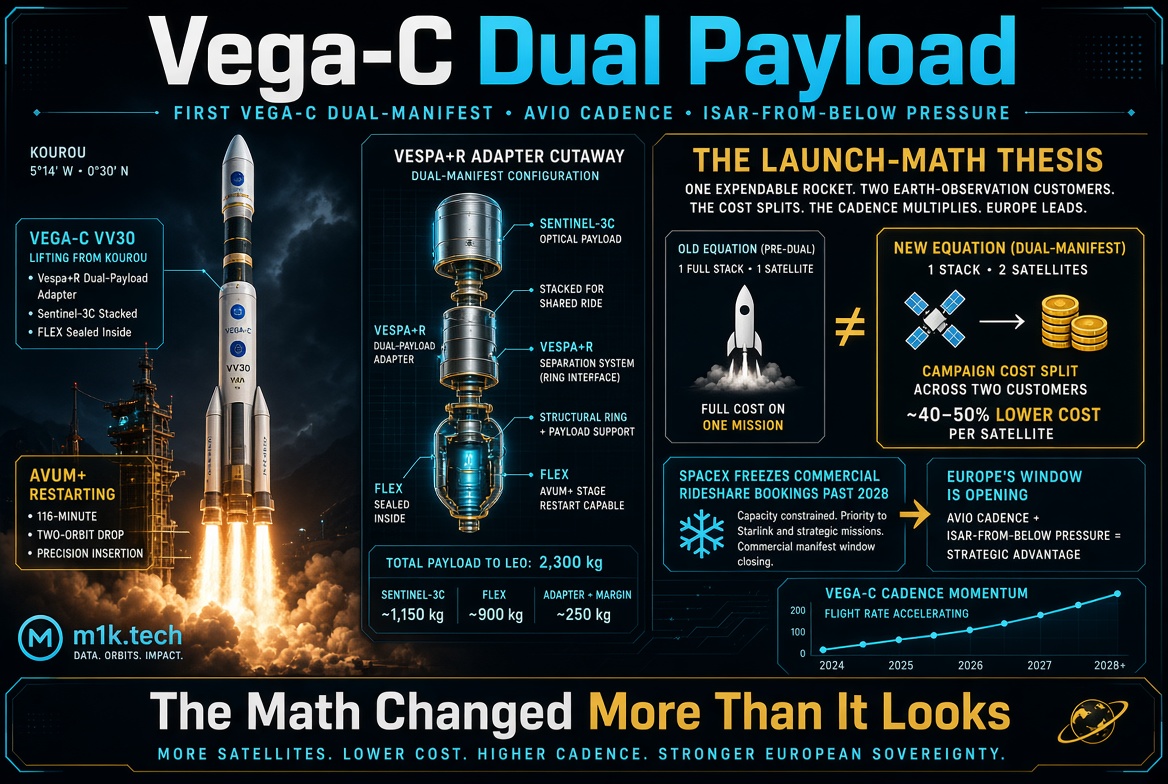
Fifty-five minutes and twenty-eight seconds into VV30, the first Vega-C dual payload mission, the AVUM+ upper stage relit, and roughly five minutes later Sentinel-3C drifted away at around 810 km. The rocket wasn’t done. It still had ESA’s FLEX tucked inside an adapter underneath, and it spent close to another hour maneuvering before letting that one go too. VV30 left Kourou on 15 September at 03:21 CEST (22:21 local time on the 14th), and once ESA’s operations center in Darmstadt picked up signals from both spacecraft, Europe’s mid-size launcher had carried two satellites to orbit on the same flight for the first time.
Rockets aren’t my core lane; I spend most of my time on chips, so weigh my launcher opinions accordingly. This one still grabbed me, because it’s the kind of milestone that reads as a footnote in a press release and then quietly decides who makes money for the next five years.
The enabling hardware is Vespa, the secondary payload adapter (ESA’s prelaunch material calls this version Vespa+R). Think of it as a hollow structural shell bolted to the fourth stage. FLEX rides sealed inside its lower section, and Sentinel-3C, the larger Copernicus satellite, is mated on top of it. That stacking order dictates everything: Sentinel-3C has to leave first, the upper part of Vespa then comes away to expose FLEX, and AVUM+ burns again to set up the second release. Liftoff to final separation took 116 minutes, a long flight for a vehicle whose first three stages are solid motors that finish within minutes. The long tail is all AVUM+, a restartable liquid stage, and ESA says VV30 demonstrated it can drop two Earth-observation missions into their different required orbits. Both are sun-synchronous at roughly 98.6 degrees of inclination, and FLEX is built to fly in tandem with one of the Sentinel-3 satellites, so the relative phasing between them is part of the science, not a nice extra.
The “first” deserves a small asterisk. Vespa isn’t new. The original Vega flew it back in 2013 on VV02, pairing Proba-V with Vietnam’s VNREDSat-1. What’s new is proving the concept on Vega-C, the bigger evolution that can put about 2,300 kg into low Earth orbit, stands 35 m tall and weighs 210 tonnes on the pad, at a moment when the program badly needs to look boring. Vega-C still carries the scar of 21 December 2022, when the Pléiades Neo 5 and 6 mission failed. Every clean flight since then is partly an argument about that night.
FLEX itself is the fun part scientifically. Its Fluorescence Imaging Spectrometer is designed to pick up the faint glow plants emit while photosynthesizing, a signal the eye can’t see that shifts with plant stress and health, and that feeds straight into how scientists model the carbon and water cycles. I’m not going to pretend I can do the spectroscopy justice here; that deserves its own post with someone who actually works on it. Sentinel-3C is the continuity piece: the third unit in a series whose ocean, land, ice, and atmosphere data has been flowing for a decade, and which ESA and Eumetsat operate jointly for the European Commission once commissioning wraps up. Forecasters lean on that data in near real time, which is why nobody at Eumetsat wanted a gap in the series.
What makes me care about an adapter is launch economics. An expendable, mostly solid-fuel rocket burns its full set of motors every time, whether the fairing holds one satellite or two. Every flight that leaves capacity unused is money set on fire, and Europe’s institutional Earth-observation pipeline is packed with mid-sized spacecraft: Copernicus expansion missions, future Earth Explorers, Italy’s IRIDE constellation. A flight-proven dual-manifest configuration lets ESA and the Commission plan pairs instead of queuing singles, and it spreads the campaign cost, range time and hardware over two customers. That part never shows up in the launch webcast, and it’s the part that matters most for the next manifest.
The business wrapper belongs to Avio now. The Italian prime took over Vega launch services from Arianespace, and VV30 is only the second Vega-C flight under that arrangement, and the second of 2026 after SMILE in May. Avio told investors earlier this year it expected up to three Vega-C launches in 2026, with the IRIDE missions and Space Belt still on the manifest, and its longer-range ambition is up to six a year. The top line looks healthy: €542 million in 2025 revenue, up 23%, a backlog of €2.166 billion, and first-half 2026 revenue of €279.7 million, up 18%. Margins tell a thinner story. Reported EBITDA was about 6% in 2025, and the stock slipped after the H1 print even though guidance held.
I keep coming back to where Avio’s growth is really coming from. Shareholders approved a capital increase of up to €400 million in October 2025, and the story leaned heavily on defense propulsion, including a US contract for a solid rocket motor for air defense and a new production footprint in Virginia. Vega-C is the showcase, while solid motors for missiles and the P120C boosters Avio builds for Ariane 6 carry much of the volume. I don’t see that as a weakness; solid rocket expertise transfers cleanly between those businesses. It does mean Vega-C’s cadence is as much a credibility exercise for the whole group as it is a profit center, and a slip on the launcher side would land on a share price that’s already twitchy.
The worldwide picture is where this gets interesting. Falcon 9 flew 165 times in 2025, more than six times the rest of the US launch industry combined, and for years SpaceX’s Transporter and Bandwagon rideshares set the price floor for anyone with a small or mid-sized satellite (I wrote about the Transporter-17 flight that carried the first commercial nuclear payload back in July). This summer SpaceX reportedly stopped taking new commercial rideshare bookings beyond late 2028. Avio CEO Giulio Ranzo has been leaning into that, arguing that SpaceX’s capacity has effectively become captive and that smaller customers are drifting toward European options. He has an obvious interest in saying so, but the booking freeze is real, and a Vega-C that can fly two payloads at once is a much easier sell to an operator who just lost a 2029 rideshare slot.
Rocket Lab’s Neutron, the vehicle most often pitched as the other medium-lift ride, is still chasing a debut, with the company targeting pad delivery in Q4 2026 and the window for a first flight this year narrowing. Neutron plays in a heavier class with reusability, so it’s not a like-for-like rival, but for a satellite operator picking a ride for 2028 it sits on the same shortlist.
Inside Europe, the pressure on Vega-C comes from below. I covered Isar Aerospace reaching orbit from Norway on 5 September, on only its second flight, and ESA signed the first European Launcher Challenge contracts in August: €197.8 million for Isar, €186.9 million for RFA, €158.9 million for PLD Space, with MaiaSpace still in negotiation. The Challenge drew €902 million in subscriptions at the last ministerial, and every provider has to reach orbit before 2028 to keep its place. Spectrum targets about 1,000 kg to LEO, RFA One about 500 kg to SSO, and Miura 5 about 540 kg to SSO, so none lift what Vega-C lifts today. They don’t need to. Many institutional payloads fit under that line, and once these companies fly on a cadence, the single-satellite Vega-C mission gets very hard to justify. Dual manifests are Avio’s best defense against being nibbled from underneath. Orbex, for the record, entered administration in February, a reminder that not everyone at that table survives.
Europe is funding a lot of rockets at the same time, and the financing question is the one I’m least comfortable with. ESA awarded Avio two contracts worth €350 million in December 2024 to raise Vega-C cadence and finish Vega E, the successor with a methalox upper stage promising roughly 20% more performance at around 20% lower cost. Vega E’s debut has already slid from late 2026 to 2027, and Avio’s newer launch contracts suggest Vega-C may keep flying until 2031. Add the Launcher Challenge money, Ariane 6’s ramp, and national spaceport spending (the UK just published a space strategy centered on ports rather than a sovereign rocket), and Europe is paying for more launch capability than its institutional payload pipeline obviously fills. It’s the same public-money pattern I flagged with the EuroHPC supercomputer contract that went to Bull: sovereign capacity first, the demand math later.
Private money is moving too. PLD Space’s Series C reached €288 million this month, and after watching Pasqal list on Nasdaq and raise well short of its target, I’m curious how long European deep-tech investors keep writing launch cheques before they ask to see a customer list. For corporates on the satellite side, Thales Alenia Space, OHB, Airbus and the IRIDE industrial team among them, the crowding is good news: more sovereign rides and more leverage on price. For investors in the launchers themselves, it’s a crowded field where scale is still unproven for everyone except the American company now closing its rideshare book.
The adapter was the easy part. What VV30 really proves is that Vega-C can do the job Europe needs it to do, but Avio’s own target of six flights a year matters, and I’ll take it seriously the first year I see four.
Sources
- ESA, FLEX and Sentinel-3C launched, September 15, 2026
- ESA, FLEX and Sentinel-3C ready for liftoff on Vega-C
- ESA, Vega-C flight VV30 with FLEX and Sentinel-3C
- NASASpaceFlight, Vega C set to launch the ESA Sentinel-3C and FLEX missions from Kourou
- Avio, FY 2025 results
- Avio, 9M 2025 highlights
- ESA, First contracts kick off European Launcher Challenge
- European Spaceflight, Avio launch deal highlights uncertainty in Vega upgrade roadmap
- Spaceflight Now, Window for 2026 launch debut of Rocket Lab’s Neutron is narrowing
- AIAA, SpaceX halts new commercial rideshare reservations beyond 2028