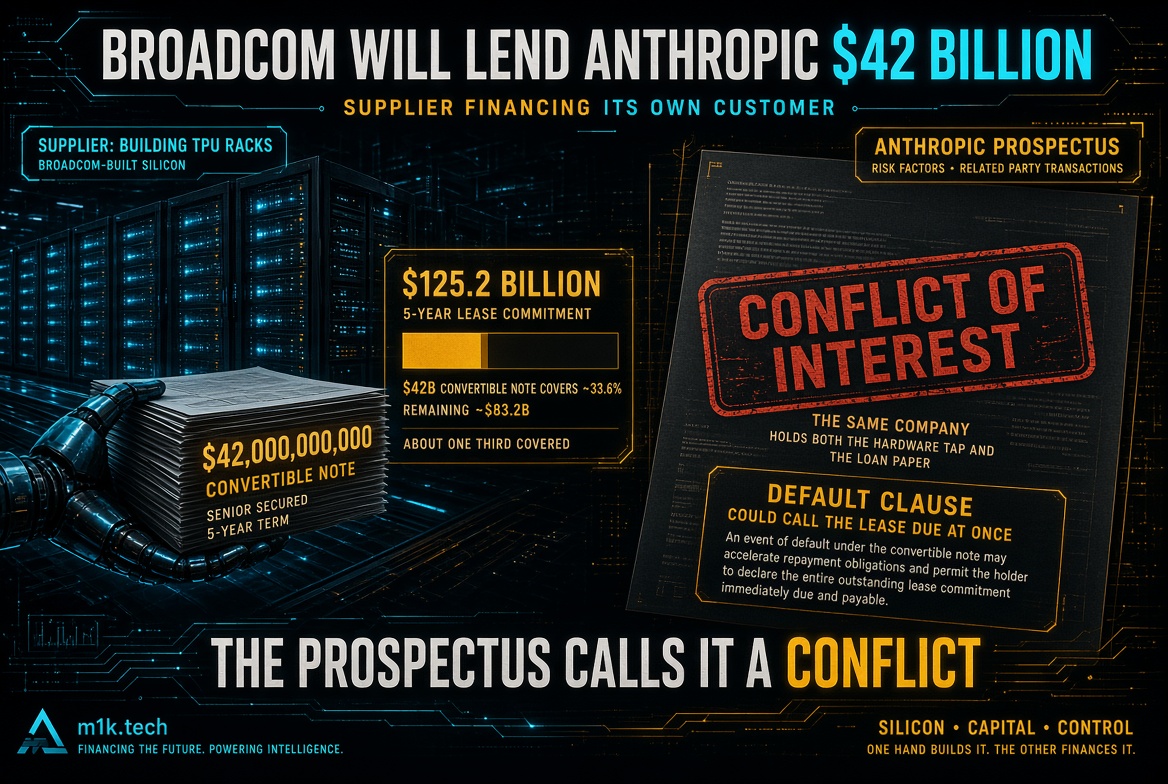
The Broadcom-Anthropic loan is the plainest picture yet of how this build-out pays for itself: according to Reuters, which reviewed Anthropic’s IPO prospectus, Broadcom has agreed to lend Anthropic up to $42 billion toward a five-year, $125.2 billion lease of tensor processing units, the chips Google designs with Broadcom. The company that helps build the hardware is also the one financing the rental. I had to read that twice.
The money would arrive as convertible notes that can turn into Anthropic shares, covering roughly a third of the lease. Broadcom gets to name a financing partner, and Anthropic says in the filing that it doesn’t expect any notes to be sold before the IPO. Anthropic also put cash into a restricted account for Broadcom’s benefit back in April, and it may have to add more under certain circumstances. That is a lot of collateral movement for a loan nobody has drawn yet.
What caught my attention is the wording Anthropic chose for its own investors. The prospectus says Broadcom’s double role as hardware supplier and financing partner creates “potential conflicts of interest,” which could affect Anthropic’s access to the compute it needs, and that Broadcom’s decisions on pricing and hardware could limit how much infrastructure Anthropic can buy at all. A borrower is telling the public market that its lender also controls the tap. There is also a default clause: if payments or performance slip, much of the lease could come due at once, and the $42 billion facility would cover only a limited slice of that.
Nvidia has been walking this road for months, and I covered the shape of it when its $105 billion guarantee on the Ohio PORTS-Pike project showed up. The Financial Times reported this week that Nvidia has even talked to insurers about loans backed by its chips. Seaport Research’s Jay Goldberg put it bluntly to Reuters: Nvidia is putting a massive amount of its balance sheet on the line, and Broadcom is having to follow suit. “Having to” is the part I’d underline. Suppliers who finance their customers are not being generous; they are keeping the order book alive.
For Anthropic, the arithmetic is uncomfortable in a different way. The same prospectus shows a $42 billion loss in 2025 against revenue that grew twelvefold, with an IPO that Reuters says could value the company at $2 trillion. What matters here is the direction of dependence. Anthropic hired the person who built Google’s TPU program and spent August announcing a $5 billion AMD bet to loosen Nvidia’s grip, and a loan like this pulls it further into the TPU lane, with Broadcom holding paper that converts into Anthropic equity. It is hard to call that diversification.
Broadcom’s own numbers explain why it would do this. Reuters says Anthropic is on course to become Broadcom’s largest compute customer in 2027, and Broadcom projects AI chip revenue of about $115 billion in fiscal 2027 and $230 billion in fiscal 2028. A lender with that much revenue riding on one customer has every reason to keep the customer solvent. Rothschild’s Robert Leitao told Reuters it feels like a concentrated bet that a couple of companies can earn enough to support all the financing that has happened, and that list is very short.
One caveat I’d flag before anyone quotes these figures: they come from Reuters’s reading of a filing the rest of us haven’t seen, and Broadcom and Anthropic both declined to comment. What I can’t answer yet is what a supplier-lender actually does when its customer-borrower misses a quarter. The prospectus warns about it, and I’d like to hear the first earnings call where somebody asks.
Sources
- The Next Web, Broadcom will lend Anthropic up to $42bn to lease its AI chips (summarizing Reuters reporting on the prospectus), October 1, 2026
- Yahoo Finance, Broadcom to lend Anthropic up to $42 billion to lease chips, in latest circular investing deal, October 1, 2026