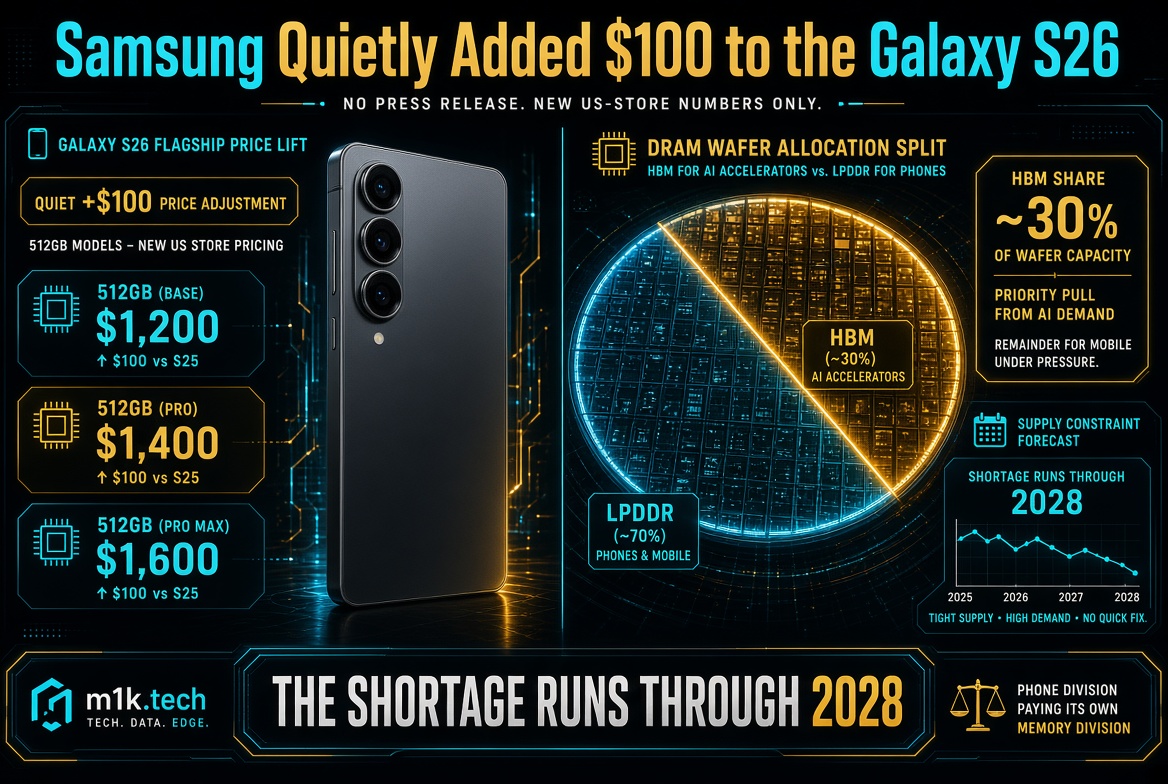
The Galaxy S26 price increase arrived on Thursday the way these things do now: no press release, no blog post, just new numbers on Samsung’s US store. The S26, S26 Plus and S26 Ultra all went up $100, so the larger 512GB versions now list at $1,200, $1,400 and $1,600, and the 1TB Ultra climbed $200 to $2,000. The S26 FE didn’t move, and neither did the new Z Fold 8, Fold 8 Ultra, or Flip 8, which tells me Samsung is repricing the phones whose launch margins it can no longer defend rather than the ones it just set fresh.
Nobody at Samsung explained it, and CNET says the company hadn’t responded by the time it published. Nobody needed to. Apple and Google both added roughly $100 to their latest phones, and the cause is the same one I’ve been writing about since July: AI data centers are eating the memory supply. I tracked the first leg of this when Nvidia’s server price hike put a $100 tax on a Galaxy Fold, and a $100 bump on the flagship line is the second.
More interesting numbers came from Samsung’s own memory side that same week. Executive vice president Kim Taewoo said on Tuesday that high-bandwidth memory should take nearly 30% of DRAM makers’ wafer capacity next year, up from about 20% now, and that HBM and standard DRAM compete for the same wafers. That one sentence is the whole phone price story. Every wafer that becomes an HBM stack for an AI accelerator is a wafer that doesn’t become LPDDR for a handset, and Samsung is both sides of that trade. Back on its July earnings call it already said the shortage would be worse next year and last through 2028.
Micron’s quarter is the profit side of the same ledger. Its fiscal fourth quarter brought $54.2 billion in revenue, about $3 billion above the roughly $51 billion analysts expected, and Gizmodo reports DRAM revenue up 343% from a year ago. CEO Sanjay Mehrotra’s explanation for why supply won’t snap back is mundane in a way I find convincing: even after new fabs are built and first wafers come off, he said, production ramps gradually inside the clean rooms. You can be cynical about suppliers enjoying the scarcity (I am, a little), but a fab doesn’t care how much you want it to hurry.
I think Samsung’s chip division and its phone division are increasingly negotiating against each other, a tension I got into when it validated LPDDR6 on a Snapdragon it might not buy. If the memory outlook holds, I’d expect the Galaxy S27 to start from a higher floor than this one did, though that is my guess, not anything Samsung has said. Qualcomm’s own stage in Maui had a price tag on it that went up too, which I noted in my Summit Day 2 write-up, and the same pressure is why a $1,059 headset needed a RAM explanation in my Steam Frame piece.
There is one small mercy. Amazon still lists the Ultra below Samsung’s new price, and Prime Day runs October 6 and 7, so the people who wait a few days may get the old number back for a moment. I wouldn’t count on that lasting. What I still can’t tell is whether 2028 is a forecast or a pricing strategy, and I suspect Samsung can’t tell either.
Sources
- CNET, Samsung Suddenly Raises Prices $100 on Most Galaxy S26 Phones, October 1, 2026
- Reuters, Samsung Electronics says HBM to account for nearly 30% of industry DRAM capacity next year, September 29, 2026
- Gizmodo, Micron’s DRAM Revenue Shot Up 343% Compared to Last Year, Courtesy of RAM Shortage, September 30, 2026
- Boing Boing, RAM shortage to last two more years, say top manufacturers, October 1, 2026