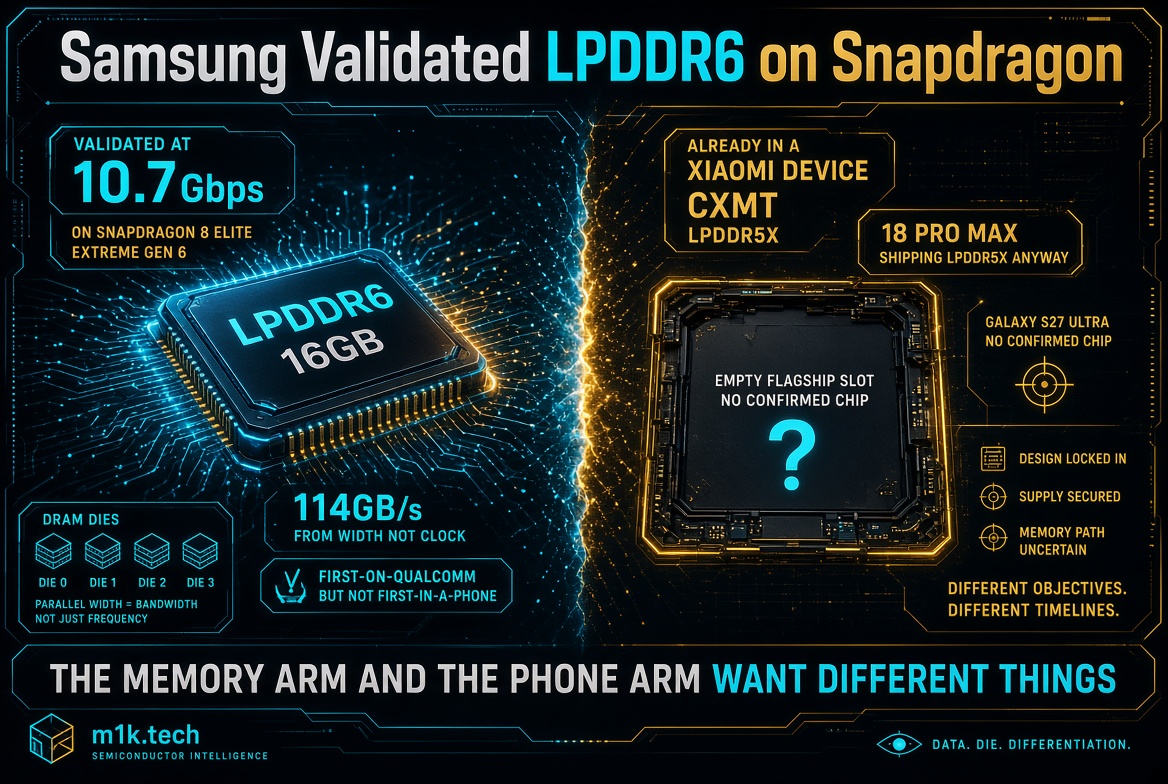
10.7 gigabits per second per pin. That is the headline figure on Samsung’s announcement that its 16GB LPDDR6 passed validation on the Snapdragon 8 Elite Extreme Gen 6, and it is exactly the same peak speed the fastest LPDDR5X already hits in shipping phones. If you only read the pin speed, the first LPDDR6 validation on a Qualcomm flagship looks like a sideways step. It isn’t, but the reason it isn’t has nothing to do with the number Samsung put in the headline.
Samsung Semiconductor published the news on September 23, Summit Day 2, while its own phone division was nowhere on the Maui stage. Jangseok Choi from Samsung’s memory product planning team called it the completion of sampling and validation on Qualcomm’s next-generation platform; Qualcomm’s Salman Saeed called it close collaboration. What caught my attention is the precise wording: the industry’s first LPDDR6 validation on Qualcomm’s new mobile platform. Not the first LPDDR6 in a phone. That qualifier is doing a lot of work, and I’ll get to why.
I flagged this story in my Day 1 Summit post without chasing it, because the whole dual-flagship split came down to memory: LPDDR6 support is one of the lines Qualcomm drew between the Extreme and the regular Gen 6. A validation announcement is the moment that line stops being a spec-sheet checkbox and starts being a supply decision somebody has to pay for.
Where the bandwidth actually comes from
LPDDR6 gets its gains from width and efficiency, not from a faster clock on day one. Samsung quotes up to 114GB/s of bandwidth for the validated part, which it credits to higher per-pin speed and an expanded I/O architecture. The JEDEC standard reorganizes each channel into 24 bits split into two 12-bit sub-channels, and spends some of those bits on metadata rather than pure payload, which is why pin-speed math undersells LPDDR6 and naive bus-width math oversells it.
Here is the comparison I did on a napkin. A typical flagship LPDDR5X interface is 64 bits wide, so at 10.7Gbps it tops out around 85.6GB/s. Samsung’s validated 114GB/s is roughly a third more at the same pin speed. Samsung’s marketing line, repeated across its materials, is up to 45 percent more bandwidth than LPDDR5X and up to 21 percent better power efficiency, and 45 percent over 85.6 lands near 124GB/s, which lines up with the roughly 125 figure Korean press quoted. So the validation Samsung just announced is not the ceiling of its own marketing claim. It’s the first rung, and the standard is written to climb to 14.4Gbps per pin in later parts. The efficiency side leans on dynamic voltage and frequency scaling plus a Dynamic Efficiency Mode that throttles how hard the memory works when the workload doesn’t need it.
A phone needs a third more memory bandwidth for the same reason Qualcomm split its flagship. On-device AI inference is bound by how fast weights move from DRAM into the NPU far more than by raw compute, and the Extreme’s pitch in Maui leaned on exactly that: bigger shared memory on the Hexagon, Matrix Cores in the Adreno, the 30B mixture-of-experts model streamed from flash. A leaked screenshot from a Snapdragon 8 Elite Extreme Gen 6 reference design makes the point sharper than any slide: the same chip scored 4,345,058 in AiTuTu with LPDDR6 and 3,602,073 with LPDDR5X, a gap of about 21 percent from memory alone. I’d treat a single leaked screenshot cautiously, but the direction matches everything Qualcomm said on stage. It also reframes this week’s power data: a meaningful chunk of what makes the Extreme the Extreme may be the memory bus, not the silicon.
That’s the part of this I find most interesting and least discussed. If the Extreme’s AI advantage is substantially a memory advantage, then an Extreme paired with LPDDR5X to save money is a very expensive chip running with one hand tied. And the memory market is exactly where phone makers are trying to save money right now.
The first LPDDR6 phones aren’t waiting for Samsung
Some of the coverage this week framed LPDDR6 phones as a first-quarter-2027 event, arriving with Snapdragon flagships built on the Extreme. That timeline is already wrong, and it’s wrong in a way Samsung should not enjoy. CXMT, the Chinese DRAM maker I wrote about when its LPDDR6 progress mattered more than its Beijing expansion, announced in August that its LPDDR6 had entered mass production and that Xiaomi’s 18 Fold would debut it alongside the Xring O3, with the Xiaomi Pad 9 Pro Max following on the same chip and memory combination. The first LPDDR6 in a Xiaomi device is a Chinese SoC on Chinese memory. Samsung’s first-on-Qualcomm is a real milestone, just a narrower one than the headline suggests.
Then there’s the Xiaomi 18 Pro Max itself, the first Extreme phone on sale anywhere. Pre-launch leaks and a handful of retail listings promised LPDDR6 and UFS 5.0, and I went digging because the listings still disagree. The phone Xiaomi actually shipped on September 23 uses LPDDR5X at 9,600MT/s with UFS 4.1 storage, across every configuration from 12GB/256GB to 16GB/1TB. That’s on the launch spec sheets published in China and in AnTuTu’s own hands-on, which ran the phone to 4,443,544 points. So the first Extreme phone on the market skips LPDDR6, and it doesn’t even use the 10.7Gbps LPDDR5X the fastest current phones run; it sits a step below that. The expensive chip with one hand tied that I described above turns out to be the launch device. And Xiaomi made that call on a phone it priced 1,000 yuan higher than last year’s equivalent, which tells you exactly how brutal the memory math is right now. The listings claiming LPDDR6 appear to have copied the pre-launch leaks rather than the box.
The competitive field is moving fast, with Samsung behind. SK hynix has completed development of its own 1c-process LPDDR6 at the same 10.7Gbps starting speed, with mass production slated for the second half of this year. CXMT is working toward a 12.8Gbps LPDDR6 design, which would leapfrog both Korean suppliers on paper if it validates. Samsung is still the biggest name in mobile DRAM, with about 43 percent of revenue share in the first quarter by Omdia’s count, and validating first on the chip every premium Android OEM is evaluating is how you defend that share. It’s the same play Samsung ran on the previous generation: unveil LPDDR5X in 2021, validate on Snapdragon in 2022, then validate on MediaTek’s Dimensity and ride both into mass production.
The volume curve explains why being early on Qualcomm matters so much and so little at the same time. Omdia forecasts LPDDR6 at 3 percent of LPDDR bit shipments in 2027, 9 percent in 2028, 21 percent in 2029, and 39 percent in 2030. Next year’s LPDDR6 market is a premium sliver, basically Extreme phones, gaming phones, and whatever Xiaomi puts on its own silicon. Winning that sliver isn’t about 2027 revenue. It’s about which supplier’s part is already qualified in the reference designs when the curve bends in 2029.
One company, three hats, one Galaxy S27 Ultra
What makes this story more than a memory press release is who Samsung is to Qualcomm this month, because the answer changes depending on which building in Suwon you ask.
Samsung Memory is a supplier courting Qualcomm and every Qualcomm customer, and it’s facing a serious memory crisis. Prices have been climbing for a year and a half; Xiaomi’s Lu Weibing expects that to continue through 2027, and the 18 Pro just launched 20 percent above the 17 Pro in China. Samsung is also one of the two companies, with SK hynix, that will stack the LPDDR dies for Qualcomm’s HBC package, the high-bandwidth memory concept Qualcomm teased in Maui and promised to show properly at MWC in March. Memory is where Samsung is winning with Qualcomm right now.
Samsung Foundry is the loser in the same relationship. Qualcomm confirmed through Chris Patrick that both Gen 6 flagships are made at TSMC on N2P, while Samsung’s 2nm yields cleared 70 percent and Qualcomm still wouldn’t pay Samsung’s price. Qualcomm keeps saying it works with both foundries, which is true in the sense that a buyer always wants a second quote.
And Samsung MX, the phone business, is the customer that hasn’t decided. Samsung wasn’t on the Gen 6 launch list, which is unusual for the company that normally anchors Qualcomm’s flagship year. The Galaxy S27 Ultra’s chip is the most contested spec in Android right now. One report from Korea’s MoneyToday says Samsung ordered Exynos 2700 mainboards for the Ultra, which would put an in-house chip in the Ultra tier for the first time since the S22 Ultra, while keeping Snapdragon development running in parallel. Another line, from leakers, says Samsung and Qualcomm finalized pricing for the top Snapdragon in the S27 Pro and Ultra. Samsung’s own claim that its 2nm Exynos beats Qualcomm’s next flagship reads differently with that order in the background.
Layer memory on top and it gets messier. Samsung’s validation covers 16GB only. One leaker says the S27 Pro and Ultra get LPDDR6 with UFS 5.1 storage, which is already suspicious because Qualcomm’s own materials reference UFS 5.0. Other reports say the S27 range sticks with LPDDR5X to control costs during the crunch, and another rumor has only one S27 model offering 16GB at all. If Samsung MX uses Exynos in the Ultra in some regions, validation done specifically against Qualcomm’s controller doesn’t automatically carry over.
The partnership map around this is dense. Qualcomm currently supplies the Snapdragon 8 Elite Gen 5 for the Galaxy Z Fold 8 and Fold 8 Ultra, Snapdragon Wear Elite for the Galaxy Watch 9 and Watch Ultra 2, the AR1 in Samsung’s intelligent eyewear built with Google, and the XR2+ Gen 2 in Galaxy XR. Samsung sells Qualcomm memory, loses Qualcomm’s wafers, and buys Qualcomm’s chips while building a chip to replace them. I don’t think any other supplier relationship in the industry has this many simultaneous loyalties.
Why Samsung Memory announced this during somebody else’s show
The go-to-market logic is simple once you see who the audience was. Samsung Memory isn’t marketing to consumers; nobody buys a phone because of a DRAM vendor. It was marketing to the dozen OEMs whose product planners were sitting in Maui deciding their Extreme bills of materials, and to Samsung MX, which is one of those OEMs. Announcing the day after Qualcomm unveiled the Extreme, while every Extreme customer was in one place, is the memory equivalent of handing out business cards at the right party. The Qualcomm quote in the release matters for the same reason: it gives every procurement team a reference validation they can cite internally.
It also puts subtle pressure on Samsung’s own phone division. If the S27 Ultra ships with LPDDR5X while Samsung’s memory arm is loudly first on LPDDR6 for the chip inside it, the spec comparison against a Xiaomi or OnePlus Extreme phone writes itself, and not in Samsung’s favor. I don’t think that’s an accident. Samsung’s divisions run with real independence, and a public validation is one of the few levers memory has on mobile.
I’m not getting into HBM or Samsung’s data-center memory position here; that’s a different market with a different buyer, and it would double the length of this. The mobile story is enough.
My read, for what it’s worth: the S27 Ultra ends up with LPDDR6 only in the top configuration, the 16GB model that matches the exact part Samsung just validated, and LPDDR5X everywhere below it. The memory division needs a flagship showcase, and the phone division needs its margins back, and a split configuration gives both of them something to put in a press release. What I can’t call is the chip underneath. Samsung validated its memory on a Snapdragon it may not buy in every market, for a phone whose processor it hasn’t announced, while its foundry lost the order to make that Snapdragon in the first place. Ask me again in February.
Sources
- Samsung Semiconductor: LPDDR6 industry-first validation on Qualcomm’s new Snapdragon platform
- Seoul Economic Daily: Samsung validates LPDDR6 on Qualcomm chip, Omdia forecast
- Quest Review Center: Samsung mobile DRAM share and LPDDR5X validation history
- Electronics USA: SK hynix and CXMT LPDDR6 status
- SammyGuru: leaked AiTuTu scores, LPDDR6 versus LPDDR5X on the Extreme reference design
- Notebookcheck: Xiaomi 18 Fold set to debut CXMT’s LPDDR6
- Gadget Hacks: Galaxy S27 Ultra Exynos 2700 mainboard order, per MoneyToday
- PhoneArena: Galaxy S27 Pro and Ultra LPDDR6 rumors
- SamMobile: Samsung validates LPDDR6 for the Galaxy S27 Ultra’s Snapdragon chip
- AnTuTu: Xiaomi 18 Pro Max hands-on, 9,600Mbps LPDDR5X and UFS 4.1 (Chinese)
- PhoneArena: Xiaomi 18 Pro and 18 Pro Max official specs