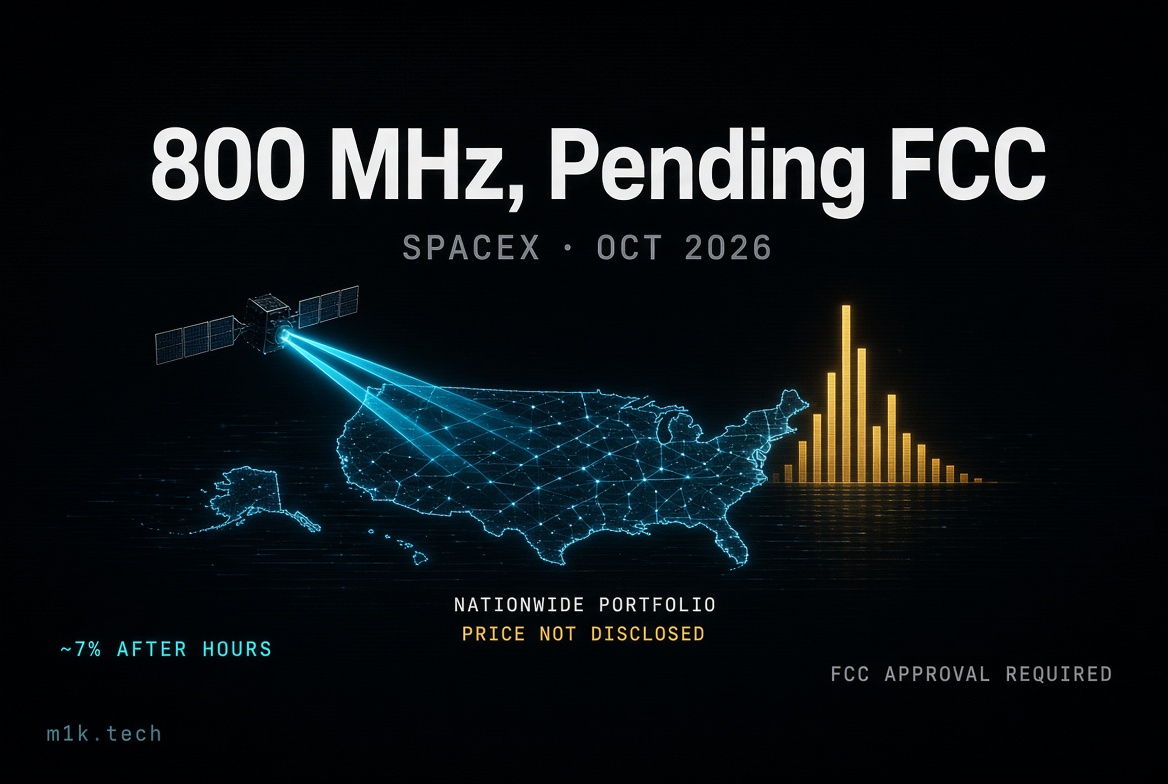
The 800 MHz spectrum deal SpaceX struck with Grain Management on October 8 took roughly 7% off AT&T, Verizon, and T-Mobile in after-hours trading, according to analyst Vish Nandlall, which is a lot of market panic for a slice of low-band airwaves with no disclosed price. Grain said SpaceX will buy 100 percent of its nationwide 800 MHz portfolio, subject to FCC approval and other closing conditions. The Wall Street Journal valued it at around $8 billion, per RCR Wireless; neither company has confirmed a figure.
The spectrum amounts to up to 14 MHz of paired 800 MHz, and the history makes it better theatre than a normal license sale. Grain got the portfolio from T-Mobile in August in exchange for cash and its own 600 MHz holdings, so T-Mobile’s old spectrum now sits with a rival with far bigger ambitions than Grain ever did. Elon Musk called it an “earthquake” and said it will enable “complete phone coverage in America”; those are his words, not a filing.
It lands one day after the FCC approved SpaceX’s request to deploy 15,000 direct-to-device satellites and waived standard leasing requirements for spectrum it bought from EchoStar, letting it pursue satellite coverage in those bands without a terrestrial partner. SpaceX says the new spectrum plus next-gen satellites will make Starlink Mobile the first operator to combine satellite and terrestrial spectrum. When I wrote about the Snapdragon X105 video calling over satellite while nobody in Maui would name the satellite, the open question was who would own both ends of that link. This is SpaceX answering for itself.
I’m skeptical of the “fourth carrier” reading, and so is Nandlall. Low-band spectrum carries far and penetrates buildings, which is coverage; a packed city block needs capacity, and that means towers and radios. Bernstein puts a competitive nationwide network at somewhere between $50 billion and $130 billion, BNP Paribas earlier estimated a US build at $100 billion across 50,000 to 70,000 sites, and Nandlall’s own arithmetic says recovering $50 billion over ten years from 20 million subscribers takes $21 per subscriber per month before any operating cost. That is a hard number to attach to a low-price challenger.
What SpaceX can do instead is cheaper and, for the incumbents, nearly as annoying: start with rural customers, vehicles and Starlink broadband bundles, and lease towers or buy wholesale capacity rather than build a duplicate network. Tower stocks American Tower, Crown Castle and SBA moved the other way after the news, and I read that as investors betting SpaceX still needs somebody else’s steel. Nandlall’s point that a $1 cut to the monthly bill across 100 million subscribers removes $1.2 billion a year from the market is the part I’d worry about if I were one of the three.
None of it reaches a handset without band and modem support, and carrier compatibility is where phone launches tend to stumble, as with the iPhone 18 Pro Max units Apple is replacing after they lost AT&T service. The incumbents have their own long game in 6G, where Qualcomm’s first partner is Viettel, but that is years from a phone near you. SpaceX is also the company behind the Texas fab I covered in SpaceX going exclusive to Nvidia while its fab’s price tag moved again, which is a reminder that Musk’s companies announce very large things faster than they finish them. The FCC decision is the thing to watch, since nothing here closes without it.
Sources
- RCR Wireless News, SpaceX grabs “earthquake” 800 MHz deal as Starlink rocks US telcos, October 9, 2026
- SpaceNews, SpaceX could seek more spectrum to feed terrestrial wireless ambitions, October 9, 2026
- NBC News, Elon Musk’s growing SpaceX empire sends AT&T, Verizon and T-Mobile shares plunging, October 9, 2026