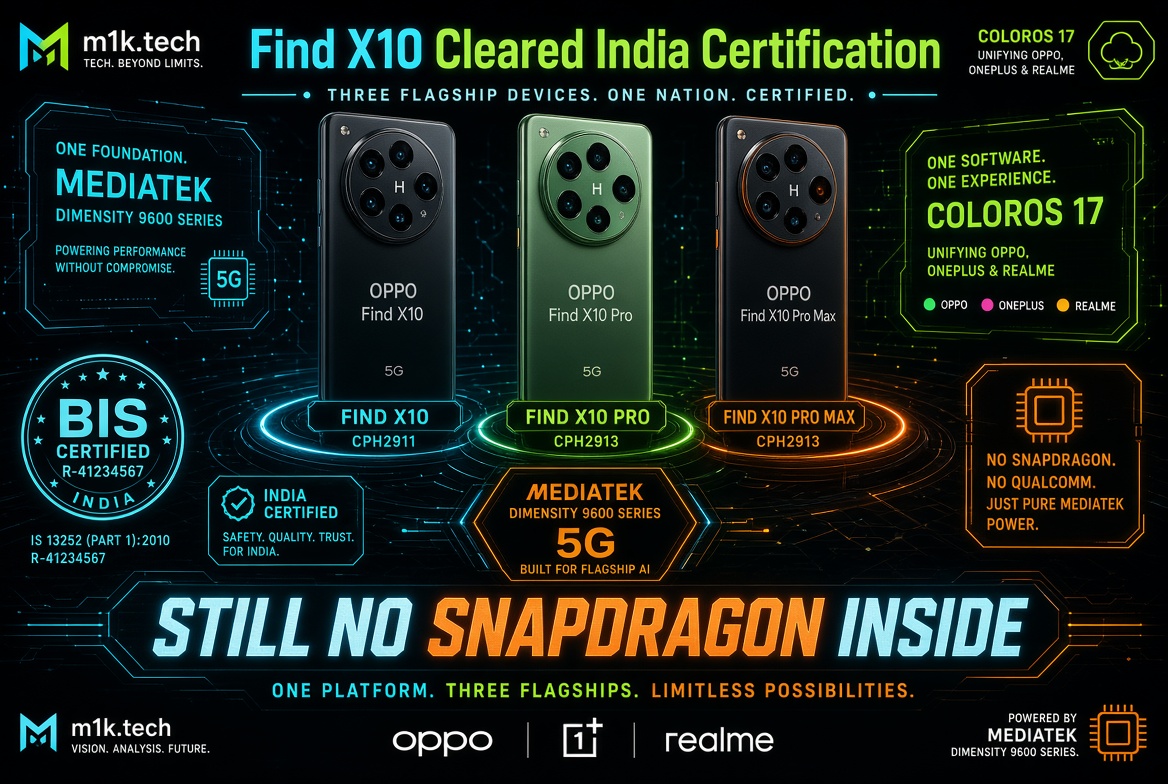
Two model numbers, CPH2911 and CPH2913, appeared in India’s Bureau of Indian Standards database this week, and that certification step is usually the last box a phone clears before Oppo brings it out of China. The tipster who spotted the listing tagged them as the Find X10 and the Find X10 Pro Max, with an India launch expected to follow the China debut by the usual few weeks. Phones get BIS listings constantly, so the certification itself isn’t the interesting part. What’s reportedly missing from inside these two is.
Both handsets are tipped to run unreleased MediaTek Dimensity 9600 series silicon, not a Snapdragon chip. That’s not new for Oppo; its flagships have leaned on MediaTek before, but the pattern is getting harder to wave off as a one-off. The Find X10 series ships three models this time around, Find X10, Find X10 Pro, and Find X10 Pro Max, one more than the two-phone Find X9 lineup from last year, and Oppo is putting all three on the same non-Qualcomm foundation. I’ve written before about MediaTek’s climb out of the budget-chip ghetto, and a company the size of Oppo betting its entire top end on it, three times over in one generation, is exactly the kind of proof point that argument needed.
September is stacked this year, Huawei, Apple, vivo, and Honor are all launching phones in the same few weeks, and Oppo timing its own event into that scrum instead of waiting it out says something about how confident it is in the chip call. It also lands right after Samsung tried making the opposite argument with its own flagship silicon, claiming its Exynos 2700 beats Qualcomm’s next chip on paper while quietly hoping nobody asks too hard about the foundry behind it. Oppo isn’t hedging the same way. It just isn’t buying Qualcomm’s story this generation, and I’d argue that’s the more interesting bet.
The bigger move sits one level up the stack. Oppo confirmed on September 2 that the Find X10 series will be the first phones running ColorOS 17, launching publicly at the Oppo Developer Conference in Zhuhai on September 17. That date matters more than it looks, because ColorOS 17 is also where OxygenOS and Realme UI stop existing as separate skins. OnePlus and Realme phones move onto the exact same software Oppo ships, the kind of internal consolidation a company only bothers with once its three brands have stopped meaningfully competing with each other. I went deep on how OnePlus got folded into Oppo’s org chart a few months back, and this is the software half of that story finally landing.
Oppo is already quoting its own benchmarks for the new build: interface smoothness up around 35 percent, app cold starts about 20 percent faster, roughly 50 percent more apps staying alive in the background. Every one of those numbers comes from Oppo, measured by Oppo, with no test conditions attached, so I’m filing them as marketing copy until somebody runs the actual build on a retail Find X10. The reported rollout figure, more than 130 devices across Oppo, OnePlus, and Realme, is even softer. It comes from pre-announcement leaks, not from anything Oppo put its name on alongside the September 17 date.
What I keep coming back to is that Oppo’s chip choice and its software unification are really the same decision made twice. Betting the flagship line on MediaTek three times over only works if the software underneath is identical enough that nobody outside a spec sheet notices which silicon they’re running, and ColorOS 17 is Oppo building exactly that cover. It’s a different kind of chip pressure than the one squeezing Xiaomi’s Poco line, which skipped an entire chipset generation over memory pricing instead of switching vendors, but both are phone brands quietly deciding Qualcomm alone isn’t worth the premium anymore. I don’t know yet whether Indian buyers will notice or care. I’ll believe Oppo’s performance numbers when someone outside its own labs reruns them.
Sources
- Gadgets360, Oppo Find X10 Pro Max, Find X10 India Launch Seems Imminent as Phones Appear on Certification Site, September 4, 2026
- 91mobiles, OPPO Find X10 Gets BIS Certified in India, Pro Max Clears Global Checks but Find X10 Pro Is Missing, September 3, 2026
- AndroidPure, ColorOS 17 Arrives September 17, With the OPPO Find X10 First in Line, September 2, 2026
- The Tech Outlook, Oppo Developer Conference (ODC) 2026 to Be Held on 17th September, ColorOS 17 Will Be Officially Released, September 3, 2026