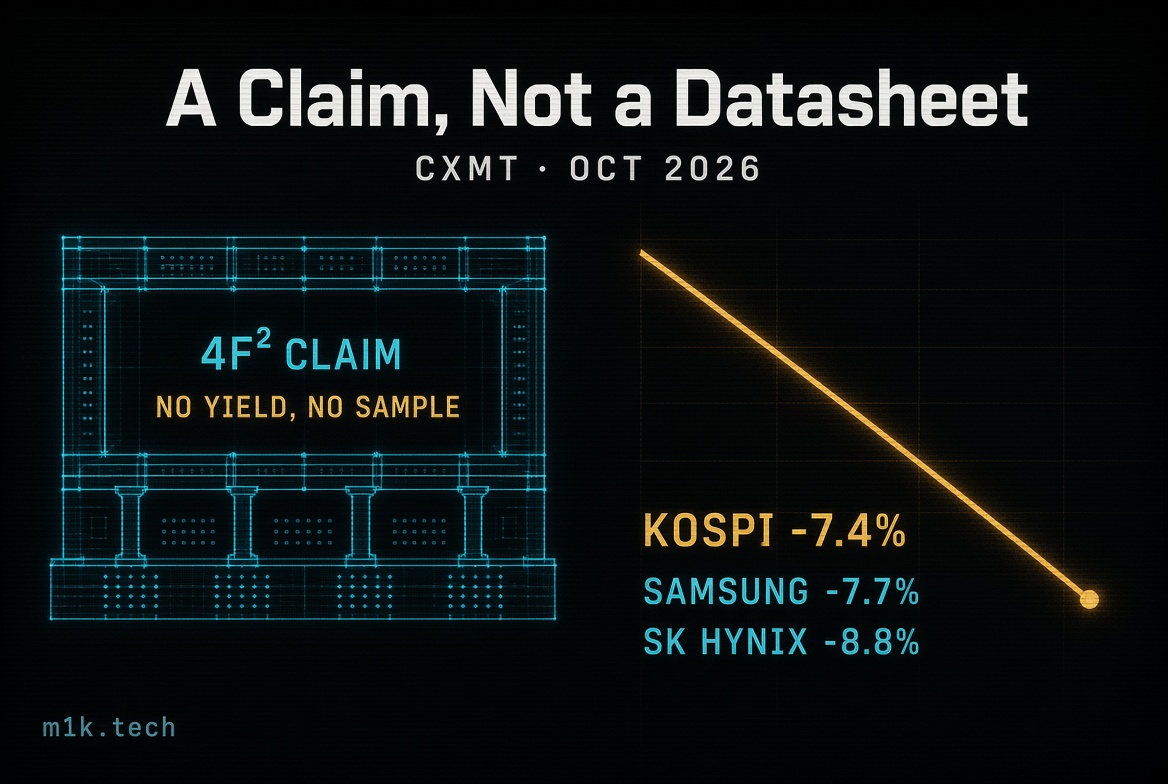
CXMT’s 4F² DRAM claim took roughly 7% off Samsung and SK Hynix on Tuesday and pulled the Kospi down 7.4% to 5,914, its lowest since late July, according to the AP. What CXMT actually supplied was a few sentences from an executive named Cao: no process data, no yield figure, no sample.
The terms first. A DRAM cell’s footprint is counted in units of F², the square of the smallest feature the process can draw, and the industry standard today is 6F². Samsung and SK Hynix are both exploring 4F², which in theory packs the same number of cells into a smaller area. Cao said CXMT is getting there by stacking transistors, a vertical surrounding-gate layout meant to cut the leakage that has plagued every attempt to go below 6F². If it works, CXMT will reach the threshold before the two Korean companies did, and it will do so without access to ASML’s top tools, which US sanctions keep out of reach, as Bloomberg points out.
CXMT also reportedly plans to build a server memory module based on the design before the end of the year, per Seoul Economic Daily.
I’m holding this one at arm’s length. In late September I wrote about a Chinese 3nm-class transistor claim that came with an evidence gap, and this has the same shape: a headline number, a workaround for the lithography ban, and nothing a reader can check. That doesn’t make it false. It makes it a statement, and the Kospi priced a statement as if it were a datasheet.
A statement was enough because of the share curve underneath it. Bloomberg has CXMT at 10% of global DRAM in the second quarter, up from 4% a year earlier, while still lagging badly in HBM, the stacked memory that goes into Nvidia’s accelerators. Samsung fell 7.7% and SK Hynix 8.8%, after Micron lost about 4% overnight in New York. Nobody was reacting to a 4F² cell that exists today; they were reacting to a company that keeps hitting its milestones and just announced another one.
What bothers me is how badly this fits the story the memory market has been telling itself. Samsung warned only a week ago that memory stays tight until 2028, and phone makers are already paying for it, which is why I looked twice at Samsung validating LPDDR6 on a Snapdragon it may not even buy. A credible second source on dense DRAM would dent the 2028 timeline, and a startup route like the one Kepler Computing says it found for HBM without EUV would dent it further. Both are claims too, which is the uncomfortable part.
The only item here with a deadline is that server module. If a CXMT DIMM on this design isn’t in someone’s hands by early next year, today’s drop will look like the most expensive remark of the autumn.
Sources
- Bloomberg, China’s CXMT Claims Memory Breakthrough Ahead of Samsung, Hynix, October 13, 2026
- The Associated Press via NBC News, South Korea’s Kospi index sinks more than 7% on semiconductor share sell-off over AI boom worries, October 13, 2026
- Seoul Economic Daily, Chinese Memory Maker’s Tech Claim Sinks Samsung, SK hynix Shares, October 13, 2026