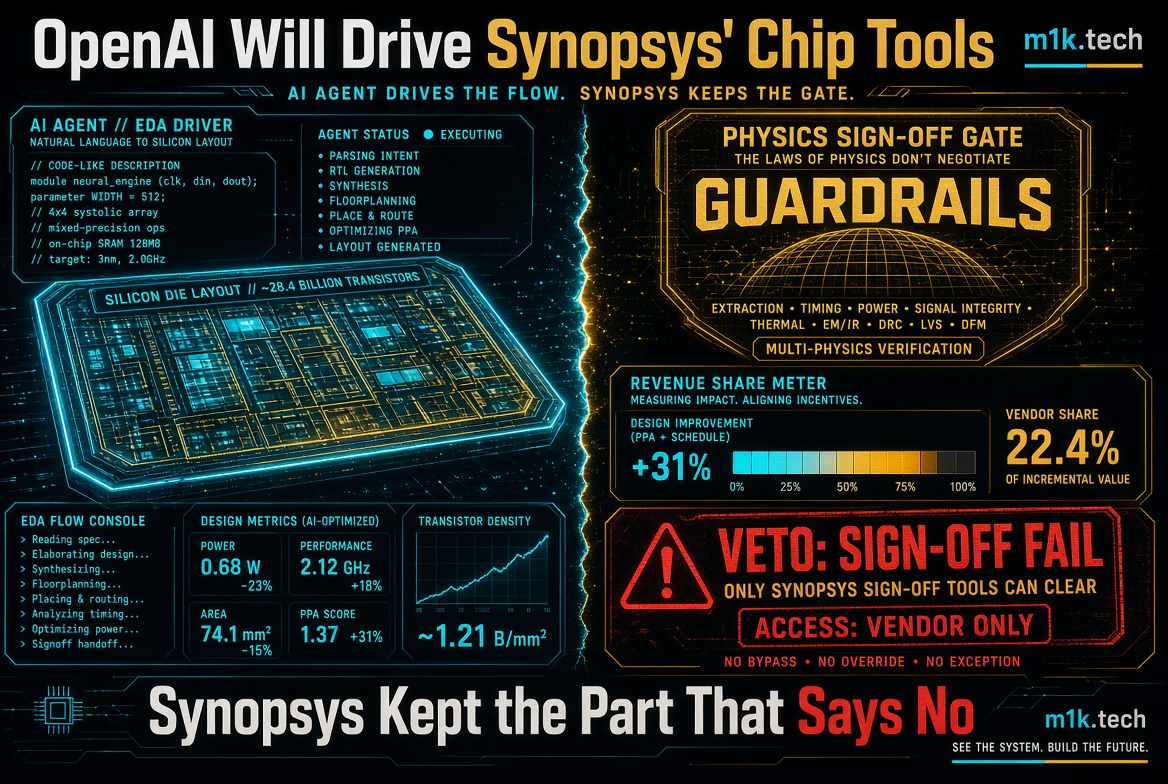
GPT-Synopsys is the model OpenAI and Synopsys announced on September 30, and what decides whether it matters has little to do with the model and a lot to do with who gets to say a chip works. Synopsys CEO Sassine Ghazi told Reuters that whatever the model produces will still be double-checked by Synopsys tools built on traditional computing, because “the model needs these guardrails in order to check the physics.” The company that sells the checker is keeping the checker.
What gets built is a model trained to take a chip described in a code-like language and carry it through to laying out billions of transistors on a small square of silicon. OpenAI licenses Synopsys’ design tools so the model can learn to operate them directly; engineers hand it objectives and review what comes back. It runs on OpenAI’s infrastructure; both companies say they won’t use customer data for training, and early tests with semiconductor customers are already underway. Greg Brockman’s pitch in the announcement video was that it could “shave off weeks, months” from a design schedule, which is the kind of sentence every EDA announcement has contained since I started reading them.
The money structure is stranger than the model. OpenAI pays Synopsys a training subscription fee for learning the tools, and when Synopsys customers use the finished product, the two companies share revenue based on how well the model improves a chip’s design. Ghazi insisted it won’t cannibalize Synopsys’ business and described it as upside. The market agreed it mattered: Synopsys also guided to 15% revenue growth for fiscal 2027 against analyst estimates of 11.19% (LSEG’s figure), and the stock rose as much as 7%. The revenue-share ratio and any exclusivity terms weren’t disclosed.
Pricing on “how well the model improves the design” sounds like a customer-friendly promise, and maybe it is. But someone has to measure the improvement, and the measuring instrument belongs to one of the two parties splitting the revenue. I’m not saying that’s a problem, only that I’d want to see how the baseline is set before I believed the framing that the incentives point at the customer.
It also lands in an odd place against what I’ve been writing about all year. In July I covered AMD’s executive claiming the CUDA moat had already drained because coding agents made porting cheap. Synopsys appears to be betting the opposite about its own business: let an agent drive the tools if you must, but the verdict has to come from software the agent didn’t write. And in June I argued that chiplets move the moat from the die to whoever owns the packaging line. Mix-and-match tiles multiply the combinations someone has to verify, and verification is the one thing Synopsys says it is not handing over.
The margins this is meant to help with are thin and getting thinner. Intel’s CTO told investors last week that 14A should land “within 5%” of TSMC’s A14, a number I picked apart in my piece on the A14 pilot run, and at that spread nobody will accept a model’s assurance that a layout closes timing. The process rules also keep moving underneath any model trained on this year’s tools: TSMC skipped High-NA for A14, then signed up for ASML’s twelve-inch photomask initiative anyway, as I wrote three weeks after Zhang said it wouldn’t need to. How quickly GPT-Synopsys relearns when a foundry changes its rules is a question I haven’t seen anyone answer, and it’s probably the first thing a customer will ask.
OpenAI is also a chip customer now, working with Broadcom on custom silicon, so it has a view into the other side of the table.
I think the revenue share is the real product here, more than the model, because it turns Synopsys from a seller of seats into a seller of outcomes with the sign-off still sitting in its own tools. Whether engineers at the customers actually trust a layout they didn’t place is a different matter, and I don’t know. If they don’t, Synopsys has sold a very expensive autocomplete.
Sources
- Reuters, Synopsys, OpenAI strike deal to develop AI model for chip design work, September 30, 2026
- The Decoder, OpenAI and Synopsys team up to build an AI model that designs chips like a seasoned engineer, September 30, 2026
- Synopsys newsroom, OpenAI and Synopsys Announce GPT-Synopsys, September 30, 2026
- NAI500, Synopsys aligns interests with OpenAI, paying by results, September 2026