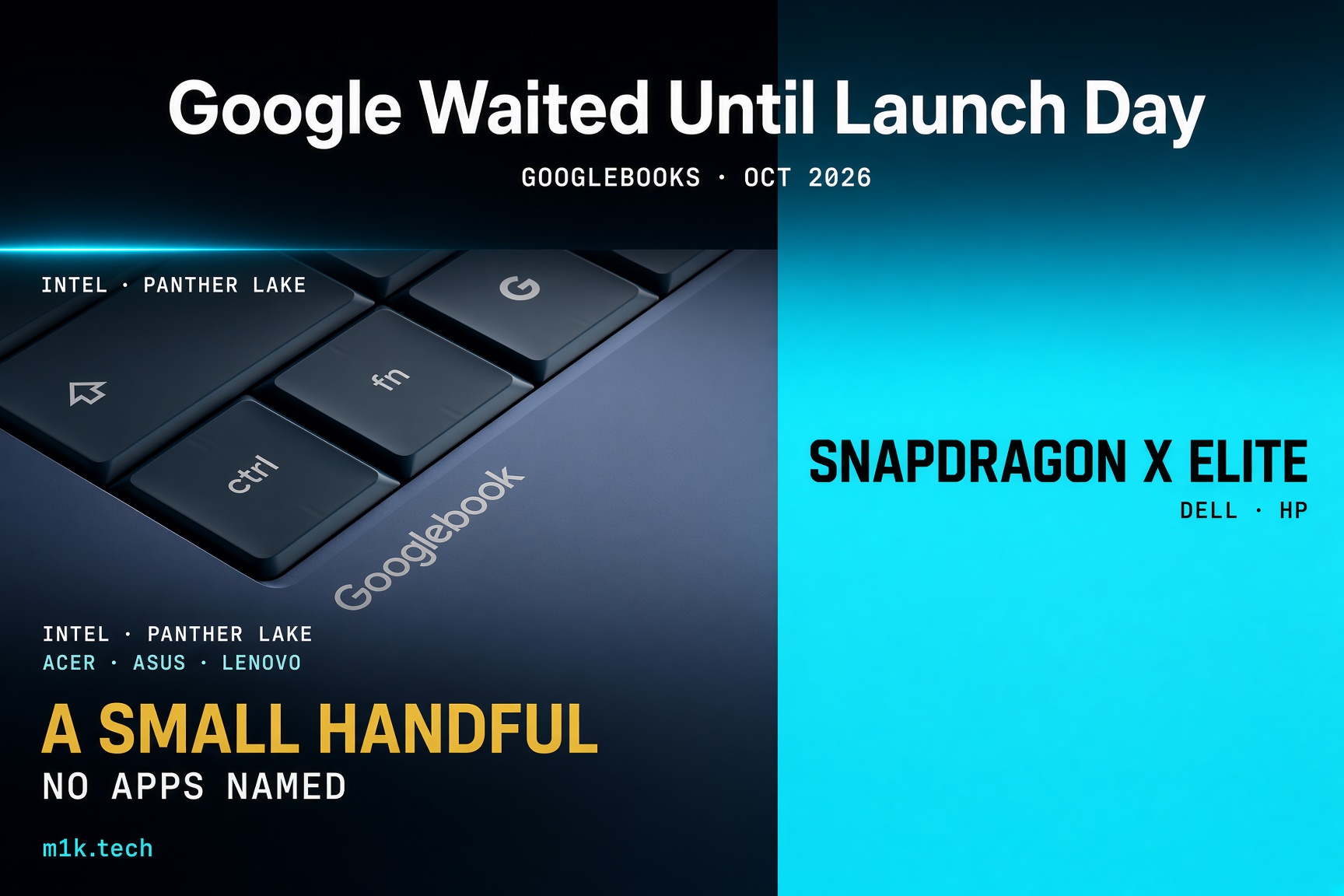
Intel Googlebooks went on sale Monday alongside a statement Google hadn’t made before launch day: a small handful of complex Android apps and games need developer tuning to run their best on the Intel-based models. Google gave the line to Android Authority, and the same statement says the vast majority of apps run smoothly on both Intel and Qualcomm Googlebooks right out of the box.
Google hasn’t said how many apps that is, and it hasn’t named one. What it did offer is a reason: many Android apps were designed for Arm chips first. Of the five Googlebooks now on sale, the Acer, Asus and Lenovo models run Intel’s Panther Lake generation, while the Dell and HP models use the Snapdragon X Elite, the 2024 chip and not the newer X2. A MediaTek Googlebook is in the works, but no machine ships with one yet.
I’ve written enough about Windows on Arm to recognise the shape of this problem, only pointed the other way. I’ve covered before how Snapdragon X laptops already lean on x86 emulation on the Windows side, and every compatibility story about them was about what broke in translation. On a Googlebook the software is Android, Arm is its native language, and the x86 machines are the ones translating. That’s funny until you notice the Intel models make up most of the first wave.
Google also didn’t say where the tuning happens, in the translation layer, in Android’s runtime or inside the apps, and the only commitment on offer is that it is working “hand-in-hand with app developers, Intel, and Qualcomm” to optimize performance. For a platform that has leaned on “the entire Play Store library” as its pitch, that is a quiet change of tone.
For Qualcomm it’s a gift with an asterisk. At Snapdragon Summit the company pitched the new laptops as one stop on a Gemini-driven path from phone to car, which I went through in my Day 1 write-up and again in Day 2’s piece on memory layers, and a Google statement that effectively lists the Qualcomm models as the ones where apps just run is about the best compatibility line a chipmaker could ask for. The asterisk is that Dell and HP launched on last generation’s X Elite. Back in May, when I looked at Snapdragon C as Qualcomm’s answer to the budget laptop trap, Googlebooks were already named as part of the competitive field, and the field now includes Intel silicon that Google itself says needs help.
Until the review units are in, “a small handful” is Google’s count and nobody else’s, and one popular game stuttering on an Intel model would settle the question faster than any statement.
Sources
- Android Authority, Google says some Googlebooks have better Android app support than others, and here’s why, October 5, 2026
- The Verge, Google admits not every Android app runs great on Intel Googlebooks, October 5, 2026
- 9to5Google, Googlebooks with Intel chipsets might have trouble with ‘complex’ Android apps, October 5, 2026