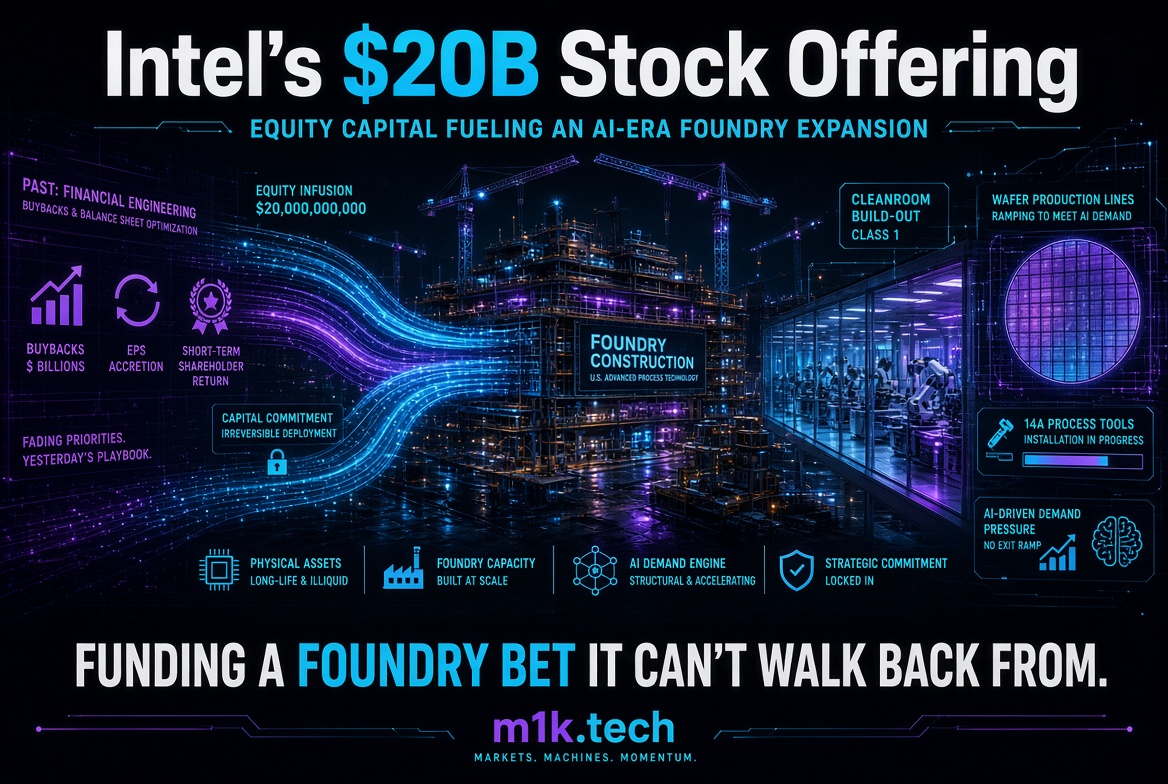
Intel’s $20 billion stock offering priced this week at $95 a share, upsized overnight from an initial $15 billion target announced Monday, and I keep coming back to how strange that sentence would have read eighteen months ago. This isn’t a modest equity top-up. Intel sold 210,526,315 new shares in a single deal, roughly 4% of the company at a stroke, to pay for capacity it has spent three years promising investors it could actually build.
The mechanics are almost boring next to the size. J.P. Morgan, Goldman Sachs, Morgan Stanley and Citigroup ran the book, the shares priced at a 2.6% discount to Monday’s close, and net proceeds land around $19.7 billion once underwriting fees clear. Underwriters also picked up a 30-day option on another 31.6 million shares, so the final number could still creep higher before the deal closes Wednesday. Intel’s own language for what the money is for, “general corporate purposes,” is doing a lot of work to avoid saying “our fabs cost more than we budgeted,” but read against the rest of this year that’s close enough to the truth.
In July, Intel raised its 2026 capex target from $18 billion to $20 billion, a large jump for a company that spent the previous three years explaining why capex needed to come down, not up. CFO David Zinsner said at the time that supply couldn’t keep pace with customer demand, and that framing matters more than it sounds like it should: it’s the first time in a while an Intel executive has described the foundry problem as too much demand rather than too little. The packaging side of that story has been building for a year. This week’s raise is the financing side finally catching up to it.
The customer giving the raise some teeth is Tesla, signed on for Intel’s 14A process through the foundry division, with high-volume 14A production committed for 2028. Tesla and SpaceX have both been threading themselves into the Texas chip manufacturing story this year, and Intel landing a real, named customer on a node still in development reads differently than another round of “customers are in the pipeline” language. The node itself is racing into the same window as everyone else’s roadmap: TSMC’s A16 brings its own backside power delivery this cycle, and the packaging-first strategies spreading across the industry mean chiplets are becoming the real differentiator ahead of any single node, which makes 14A less of a solo bet than a checkpoint everyone happens to be racing toward at once.
I don’t think the equity raise is interesting on its own; companies sell stock to fund capex constantly. What I keep noticing is the contrast with how Nvidia is solving the same underlying capacity crunch this same week: extending credit to the buyers of AI compute rather than raising cash to build the compute itself. Intel is diluting its own shareholders to build physical fabs. Nvidia is backstopping other people’s loans so someone else builds the data centers. Same industry-wide capex crunch, two opposite balance sheet answers, and neither one has proven itself yet.
There’s a sharper irony in a line from Russ Mould at AJ Bell, who pointed out this is a company that spent $82 billion on buybacks through the 2010s, “wrecking its own balance sheet and prospects by focusing on financial engineering rather than physical engineering.” Now it’s issuing new shares, at five times last year’s price, to pay for the physical engineering it spent a decade avoiding. That’s not a redemption arc. It’s just what happens once your stock rises enough that selling more of it stops being embarrassing.
Intel also quietly put €5 billion into its Irish manufacturing operations last month, a number that barely registered next to this week’s raise but points at the same pattern: a company trying to buy its way back into manufacturing relevance across several sites simultaneously, not just Arizona and Ohio. Whether 14A actually ships on schedule in 2028 is still the only number that matters here. The $95 share price and the four banks that priced it are just Intel finding a way to pay for a bet it made years ago and can’t walk back from now.
Sources
- Quartz via Yahoo Finance, Intel upsizes stock offering to $20 billion for AI chip manufacturing, August 11, 2026
- Intel Newsroom, Intel Announces Upsize and Pricing of $20 Billion Common Stock Offering, August 11, 2026
- CNBC, Intel prices $15 billion stock offering to fund AI chip push, August 10, 2026
- Reuters via AOL, Intel launches $15 billion share offering, August 10, 2026