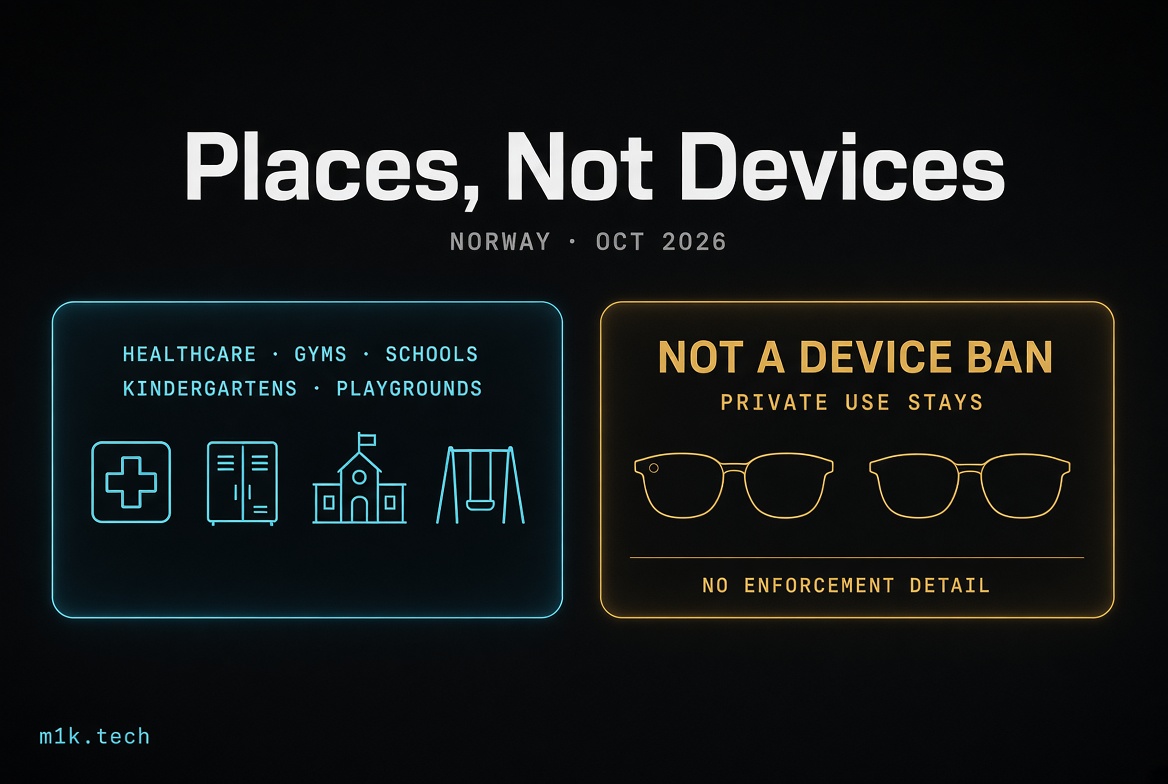
The Norway AI glasses ban, which the government said Monday it will put to the Storting as soon as possible, focuses on places rather than hardware, and I keep coming back to that choice. Digitalization minister Torgeir Micaelsen says he is worried that powerful new technology is being introduced where people risk being photographed, filmed or audio-recorded without knowing it. The list follows from that worry: it starts with healthcare facilities and gym changing rooms, moves on to schools, kindergartens, playgrounds and youth clubs, and could extend to concerts, sports events, parks, beaches, museums and shopping centers.
It is a temporary measure, and the government is careful to say it isn’t targeting wearable technology outright: private use stays, and exceptions for vulnerable groups and socially beneficial uses are being considered. The pause gives authorities time to work out which devices count and to hold what Micaelsen calls an informed debate that could lead to permanent rules.
Which devices count is the question I’d want answered first, because the category is built to be indistinguishable from ordinary frames. Samsung’s glasses with Google and Qualcomm just cleared the FCC under two product codes, one for Gentle Monster and one for Warby Parker, two names that sell frames people already wear, and one XR newsletter reads that as a launch before the end of November. Meta and Google went at the same pace during the same week in September, and Qualcomm sold chips into both. A gym attendant can’t be expected to tell frames with a camera from frames without one, and nothing in the announcement I read says how enforcement would work, so either Oslo is counting on signage and complaints or the detail hasn’t been published yet.
Compare that with California, where Gov. Newsom vetoed SB 1130 last week. The bill would have penalized secretly recording people in changing rooms and doctor’s offices, and I wrote that the veto leaves the recording LED as Meta’s promise. Norway starts from where the wearer stands rather than what the wearer records, which is a cruder tool and probably an easier one to explain to a parliament. American pressure, meanwhile, is running through the courts, where the Meta glasses lawsuit now includes bystanders who never bought a pair.
I’m not getting into whether a national ban sits comfortably with European rules; that one needs a lawyer more than it needs me. I did write this summer that the smart glasses race was having its most honest week yet on privacy and trust, and Norway is the first government I’ve come across that answers with a proposed place-by-place restriction instead of a recording rule. I’d expect the exceptions list to grow faster than the places list, and I still don’t know how a security guard is meant to tell a pair of prescription frames from a recording device. Ask me again when the text reaches the Storting.
Sources
- Reuters, Norway to propose temporary ban on AI glasses in some public places, October 5, 2026
- Associated Press, Norway seeks temporary ban on smart glasses as privacy concerns rise, October 5, 2026
- The Ghost Howls, The XR Week Peek (2026.10.05): Samsung glasses get FCC clearance, Snap opens SPECS pop-up store, and more!, October 5, 2026