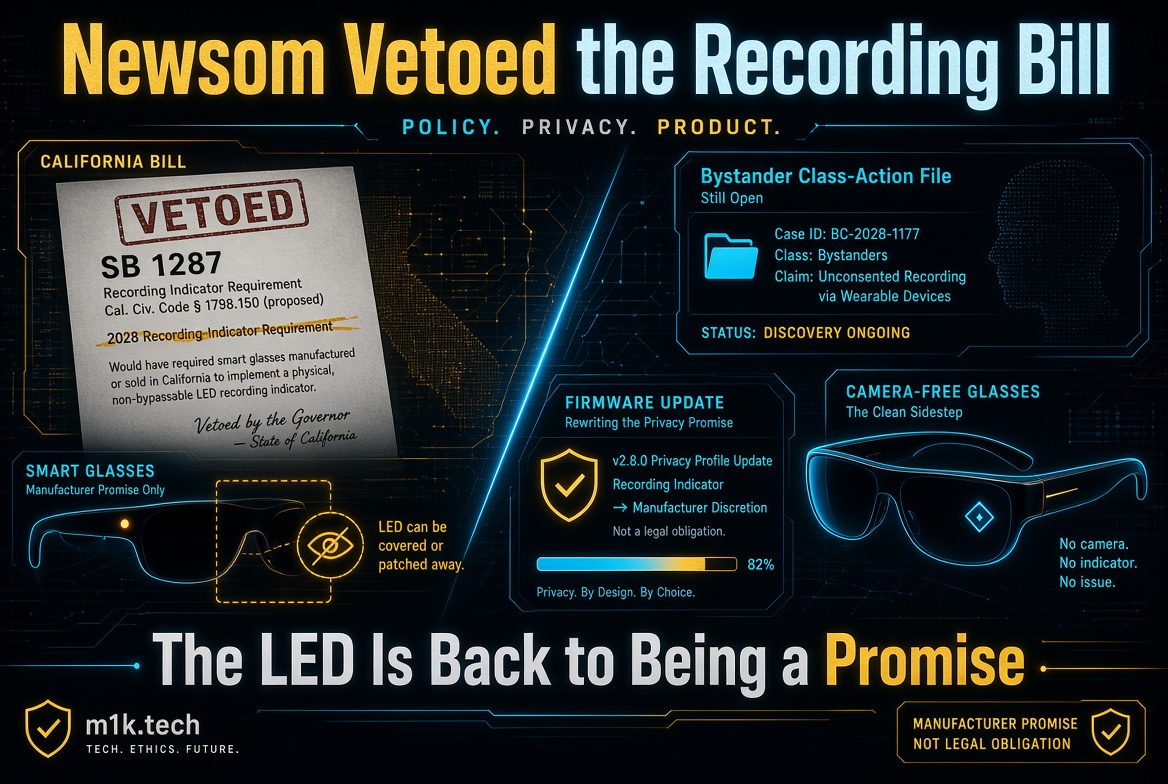
California’s legislature sent the smart glasses recording bill to Gov. Gavin Newsom as the first of its kind in the country, and on Wednesday he vetoed it. SB 1130 would have penalized secretly recording people in changing rooms, doctor’s offices and similar spaces, required makers of smart glasses and other wearables to include a light or some other signal of recording starting in 2028, and banned selling technology designed to hide that signal. An individual who violated it faced prison time or fines up to $1,500; a company shipping non-compliant devices faced up to $2,500.
Newsom’s letter objected to the definition of a wearable recording device as too broad, and noted that California already bars recording someone without consent in places generally considered private. That second point is accurate and also slightly beside it. Existing law punishes the recording after the fact, which assumes you know it happened. The bill’s real job was the 2028 indicator requirement, the part that makes a camera on someone’s face readable to the person it’s pointed at, and the veto leaves that question with the manufacturers.
The opposition came from TechNet, whose members include Meta, Google and Amazon. Its director said California already has extensive laws on unlawful recording and that SB 1130 was “not the right approach.” Meta’s response to the veto pointed to a program supplying glasses to blinded veterans for reading documents and identifying objects, and added that it will continue to prioritize privacy while the technology is early. More than 7 million of its Ray-Ban glasses sold last year, so early is doing some work in that sentence. State Sen. Eloise Gómez Reyes, who wrote the bill, said it would have helped California keep pace with the technology’s growth.
I find the timing hard to ignore because the industry’s own fix has been the LED, and I spent most of September writing about how thin that fix is. Meta has now patched the loophole twice, first for drilled-out lights and then for covered ones, and France’s data protection regulator argued in June that a light with limited range doesn’t amount to consent no matter how reliably it works. California’s bill was the first attempt in the US to make that light a legal obligation rather than a product decision, and with the veto it goes back to being a promise Meta can change in a firmware update.
The pressure doesn’t disappear with the veto; it just moves. The amended class action that added bystanders who never bought a pair is still running, and I’d expect plaintiffs’ lawyers to treat a vetoed bill as a useful exhibit: legislators saw the problem, the industry lobbied against the fix. Meanwhile, cinemas, courts and festivals keep drafting house rules, which is the pattern I described when Burning Man and UK cinemas wrote glasses policy because nobody else would. A veto doesn’t stop that, and arguably speeds it up.
The one move that sidesteps the whole argument is the one Meta made a week earlier at Connect: Ray-Ban Meta Audio, 43 grams, no camera, $349, shipping October 13. I covered that pair, and the Qualcomm earbud chip inside it, in my Connect and Summit comparison. Removing the lens is the only privacy answer that doesn’t depend on a regulator or a bystander noticing a light. I’m not going into the workplace-liability question here, whether an employer answers for a customer’s glasses filming staff; that deserves a lawyer’s answer, not mine.
Justin Brookman of Consumer Reports made the case that makes the veto’s logic feel thin to me: it’s less obvious when someone is recording with glasses than with a phone, which is exactly why a signal matters. Newsom may be right that the definition was too loose.
Sources
- The Associated Press via The Independent / inkl, Newsom vetoes measure that would have penalized the use of smart glasses to secretly record people, October 1, 2026
- AP News, Newsom rejects bill to restrict people from secretly recording with smart glasses, October 1, 2026