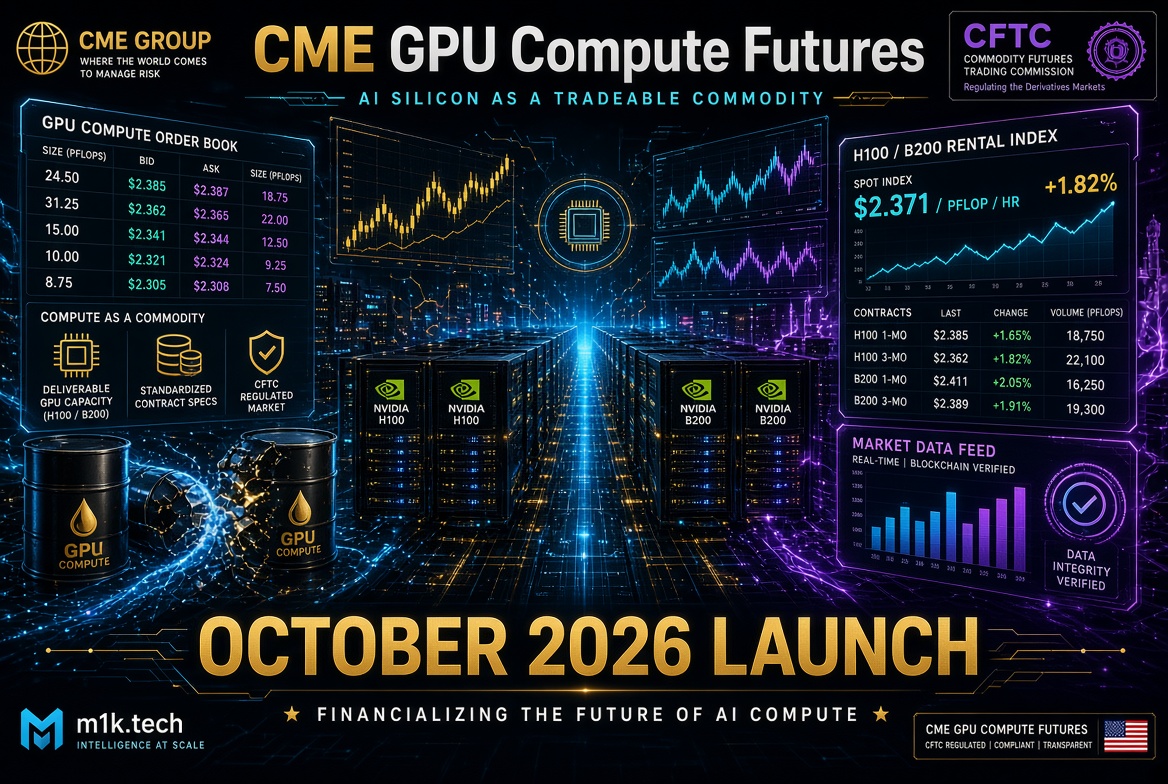
CME Group and a data firm called Silicon Data already picked the day. October 5 is when two new NYMEX-listed futures contracts go live: the Silicon Data H100 Rental Index Futures and the Silicon Data B200 Rental Index Futures, each one representing a month of rental time on Nvidia’s most in-demand chips. Compute, the same stuff that answered someone’s chatbot query an hour ago, is about to trade the same way commodity exchanges have always traded a barrel of oil.
CME’s own framing leans into that comparison directly. Pete Keavey, the exchange’s global head of energy and environmental products, the same desk that runs its oil and gas contracts, said compute has become “the currency of the AI age” when the contracts were announced. Silicon Data CEO Carmen Li called the underlying index “a public, tradable reference price for the resource every AI system runs on.” Silicon Data itself is backed by the trading firm DRW, which tells you who actually wants this market to exist. The pitch is simple enough: GPU rental prices swing hard enough that hyperscalers and AI builders would rather lock in a future cost than eat whatever the market charges that month.
The regulator that decides whether any of this is even allowed to trade spent the same week in a completely different mode. On August 19 the CFTC published a 19-page request for public comment, filed under docket RIN 3038-AF77, asking how US exchanges should list and oversee derivatives tied to AI computing capacity at all. Chairman Michael Selig wasn’t shy about the stakes: “America cannot win the AI race without a robust derivatives market for compute,” he said, calling the request “the first step toward establishing clear rules of the road for American compute markets.” The document doesn’t propose a rule, approve a contract, or authorize CME or anyone else to start trading anything. Comments stay open 60 days once it actually appears in the Federal Register, and as of Wednesday it still hadn’t been published there, so the agency hasn’t even locked in when its own clock starts.
What’s inside the 19 pages matters more than the headline. The CFTC wants input on cash market liquidity for compute, whether a benchmark reference price like Silicon Data’s is reliable enough to build a regulated contract around, manipulation risk, customer protection and retail disclosures, anti-money laundering controls, position limits, and, sitting in the same numbered list as all that market plumbing, something the agency calls the geopolitical sensitivity of advanced computing capacity. I’ve read a handful of these requests for comment over the years, and I don’t remember one that put geopolitics and market microstructure in the same document before. Compute is apparently sensitive enough to trade and sensitive enough to worry about who’s trading it, at the same time, in the same 19 pages.
None of this happens in a vacuum. Nvidia’s own $500 billion Wall Street financing arrangement that I wrote about last week is vendor credit dressed up as a headline number, and it only makes sense in a world where the thing being financed, Blackwell-class GPU capacity that keeps extending Nvidia’s own lead, is scarce enough that whoever controls it effectively sets the price for everyone downstream. A futures market is the next logical step once enough money is chasing an asset that doesn’t have a trustworthy spot price yet.
The scarcity underneath it all is real, not manufactured for the derivatives pitch. The chiplet shift across the industry this year was partly a response to exactly this kind of bottleneck, and the outside packaging houses now absorbing TSMC’s CoWoS overflow, on top of SpaceX going exclusive to Nvidia the same week its own fab’s price tag moved again, are all symptoms of the same underlying shortage. If you can’t get enough Blackwell or Hopper capacity today, the next best thing is a contract that lets you lock in tomorrow’s price for capacity you don’t have yet, and that’s exactly what CME is building toward on October 5.
I don’t fully know how you build a trustworthy reference price from GPU rental rates, and I suspect the CFTC doesn’t either yet, which is presumably why so much of the request for comment is about that question. Cloud GPU pricing varies by provider, region, contract length, and how much leverage the customer brings. Oil has decades of spot-market infrastructure behind its benchmark prices. Compute rental has whatever number Silicon Data can pull together from a handful of hyperscalers and neoclouds, and a futures contract built on a benchmark nobody fully trusts yet is how you get a market that breaks the first time somebody actually tests it.
I don’t think October 5 changes much about how AI actually gets built on that particular day. Nvidia still ships what it ships, TSMC still packages what it can package, and no physical bottleneck moves because a futures contract went live on NYMEX. What changes is who gets to bet on it. Once GPU rental capacity trades like a commodity, the people setting its price stop being only the companies that actually own the racks, and I don’t think anyone, CME included, knows yet whether that makes compute easier to plan around or just stacks another layer of speculation on top of a supply chain that’s already stretched about as thin as it can go.
Sources
- Reuters, US CFTC seeks comment on compute derivatives as AI demand grows, August 19, 2026
- crypto.news, CFTC seeks comments on AI compute derivatives, August 20, 2026
- Investing.com (Reuters wire), CME Group to launch GPU compute futures contracts in October, August 11, 2026